











TL;DR
- The European Commission banned titanium dioxide (E171) as a food additive under Regulation (EU) 2022/63, with a full prohibition effective August 7, 2025 — and because empty capsules are classified as food additives under EU Regulation (EC) No 1333/2008, any supplement brand selling TiO2-whitened capsules in the EU after that date is selling a non-compliant product, regardless of the capsule's country of manufacture.
- The regulatory trigger was EFSA's 2021 safety reassessment (EFSA Journal 2021;19(5):6585), which concluded that TiO2 "can no longer be considered safe as a food additive" because of genotoxicity concerns — specifically, the potential for TiO2 nanoparticles to accumulate in tissues and cause DNA damage — a conclusion that has since influenced regulatory reviews in the UK (FSA review ongoing), Switzerland (aligned with EU), and Gulf Cooperation Council countries (monitoring the EU precedent).
- Shancy manufactures TiO2-free empty capsules using natural mineral-based opacifiers (calcium carbonate and kaolin clay) that deliver opacity levels of 85-92% — matching the 88-95% opacity of traditional TiO2-whitened capsules — while eliminating the nanoparticle risk entirely, and the capsules are available in both gelatin (bovine and porcine) and HPMC vegetarian formulations with full DMF, HALAL, and GMP certification documentation.
- The transition to TiO2-free capsules requires coordination across three functions: regulatory (updating the product's EU label artwork and notification to the competent authority), quality (performing stability studies on the new capsule in the existing formulation), and marketing (preparing the "TiO2-free" or "E171-free" clean-label claim with the scientific rationale for the switch) — and brands that start this transition in Q1 2026 can complete it before the 2026 Q4 retail peak, while brands waiting until a competitor launches a TiO2-free product will face rush charges and production slot constraints.
The Regulatory Timeline — How EFSA's 2021 Opinion Became an EU-Wide Ban by 2025
The European Food Safety Authority (EFSA) published its updated safety assessment of titanium dioxide as a food additive on May 6, 2021. The conclusion was unambiguous: "Taking into account all available scientific studies and data, the Panel concluded that titanium dioxide can no longer be considered safe as a food additive. A critical element in reaching this conclusion was that the Panel could not exclude genotoxicity concerns after consumption of titanium dioxide particles. After oral ingestion, the absorption of titanium dioxide particles is low, however they can accumulate in the body." That last sentence — "they can accumulate in the body" — was the regulatory trigger. Under EU food law, a food additive must be demonstrably safe — the burden of proof is on the additive to show safety, not on the regulator to prove harm. Once EFSA concluded that genotoxicity could not be excluded, the legal basis for TiO2's continued use as a food additive disappeared. The European Commission adopted Regulation (EU) 2022/63 on January 14, 2022, which amended Annexes II and III of Regulation (EC) No 1333/2008 to remove titanium dioxide (E171) from the Union list of authorized food additives, with a transition period ending on August 7, 2025. During the transition period, products already on the market before February 7, 2022 could continue to be sold until their expiration date — but no new products containing E171 could be placed on the market after August 7, 2025, and all existing E171-containing products must be withdrawn from the market by their expiration date or August 7, 2026, whichever comes first.
For empty capsule manufacturers and the supplement brands they supply, the classification of empty capsules as food additives — not as food contact materials or processing aids — was the critical regulatory determination. Under EU Regulation (EC) No 1333/2008, food additives are defined as "any substance not normally consumed as a food in itself...the intentional addition of which to food for a technological purpose...results in it...becoming a component of such food." An empty capsule is intentionally added to a supplement formulation to encapsulate it, and the consumer ingests the capsule along with the supplement — so the capsule is a component of the food the consumer eats. This means that the TiO2 in the capsule body and cap — which is added to make the capsule opaque white — is a food additive under EU law, and it is subject to the same ban as TiO2 added directly to the supplement powder. A supplement brand that formulates a TiO2-free powder but encapsulates it in a TiO2-whitened capsule has not achieved TiO2-free compliance — the capsule itself is the non-compliant component. This is the most common misunderstanding I encounter when speaking with supplement brands about the TiO2 ban, and it is a regulatory trap that can result in a product being detained at EU border inspection posts, withdrawn from retail shelves, or — in the worst case — triggering a Rapid Alert System for Food and Feed (RASFF) notification that becomes a permanent entry in the brand's regulatory record. Browse our full capsule product range including gelatin, HPMC, enteric, and TiO2-free options.
What TiO2 Does in a Capsule — And Why Replacing It Is Not Simply a Matter of Leaving It Out
My name is Yubin Wu, and I am the Executive Director of Hangzhou Shancy Import and Export Trading Co., Ltd., where I lead international business development and supply chain management for our empty capsule product lines. I have been working with supplement brands through the TiO2 transition since EFSA's 2021 opinion was published, and the question I hear most often — usually from a brand's procurement team, not their regulatory team — is: "Can't we just use clear capsules instead?" The answer is technically yes, but operationally no, for most supplement brands — and understanding why requires understanding what TiO2 actually does in a capsule beyond making it white.
Titanium dioxide serves three functions in an empty capsule. First, it provides opacity — the ability of the capsule shell to block light transmission through the capsule wall. Opacity matters because many supplement ingredients are photosensitive: probiotics lose viability when exposed to UV light, omega-3 oils oxidize and become rancid, and certain vitamins (A, D, E, K) degrade through photochemical reactions. A clear capsule provides essentially zero light protection — the ingredient inside is exposed to ambient light every moment the bottle is on a retail shelf. A TiO2-whitened capsule provides approximately 88-95% opacity, reducing light transmission to the ingredient by roughly 20-fold compared to a clear capsule. Second, TiO2 provides color consistency — the uniform, bright white appearance that consumers associate with pharmaceutical quality. A batch of clear gelatin capsules will show natural color variation from batch to batch because gelatin is an animal-derived material with inherent color variability — a batch from one bovine hide supplier will be slightly more yellow than a batch from another supplier. TiO2 masks this batch-to-batch color variation, giving every capsule in every production lot the same bright white appearance. Third, TiO2 improves the capsule's machinability on high-speed filling machines — the TiO2 particles act as a lubricant at the capsule's surface, reducing the friction between the capsule and the filling machine's dosing disc, which allows the machine to run at higher speeds with fewer capsule jams. A TiO2-free capsule that has not been formulated with an alternative surface lubricant will typically show a 5-15% reduction in filling machine throughput — meaning the brand's contract manufacturer will need more machine time to fill the same number of capsules, which increases the filling cost per unit.
The solution is not to remove TiO2 and do nothing else — the solution is to replace TiO2 with a combination of alternative opacifiers that deliver equivalent opacity, a color standardization system that delivers equivalent batch-to-batch color consistency, and a surface treatment that delivers equivalent machinability. Our Shancy TiO2-free capsule range uses calcium carbonate (CaCO3) as the primary opacifier — a naturally occurring mineral that is already widely used as a food additive (E170) and pharmaceutical excipient — combined with kaolin clay for additional opacity and a food-grade surface lubricant for machinability. The calcium carbonate particles are approximately 2-5 microns in diameter — large enough that they do not raise nanoparticle concerns (unlike TiO2, where a significant fraction of the particles are in the sub-100-nanometer range) — and they are embedded in the gelatin or HPMC matrix during the capsule dipping process, not applied as a surface coating that could rub off during handling. The result is a capsule that delivers 85-92% opacity (within the 88-95% range of TiO2 capsules), consistent color from batch to batch, and filling machine throughput that matches TiO2 capsules within 5% when the surface lubricant is correctly specified for the filling machine type.
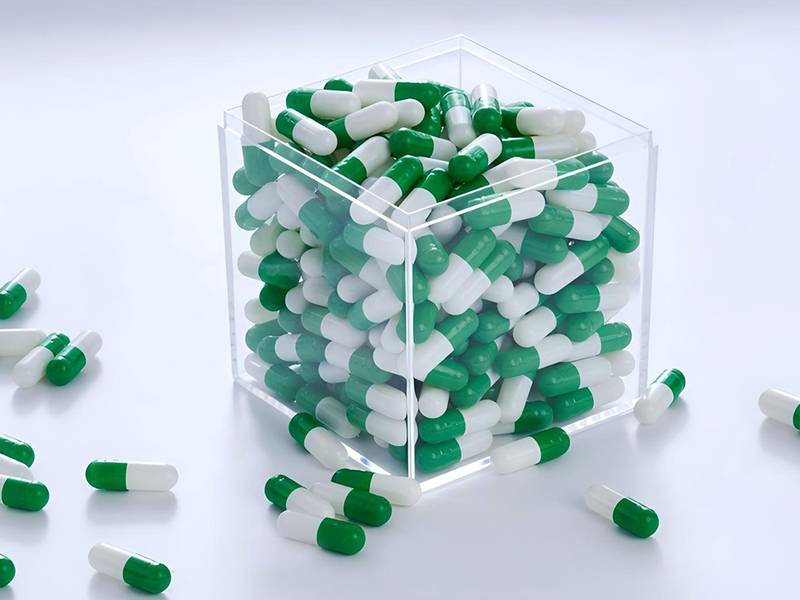
Gelatin vs. HPMC TiO2-Free Capsules — The Formulation-Specific Choice
The TiO2 ban does not distinguish between capsule shell materials — a TiO2-whitened gelatin capsule and a TiO2-whitened HPMC (hydroxypropyl methylcellulose) vegetarian capsule are both non-compliant in the EU. But the choice between gelatin and HPMC for a TiO2-free capsule has implications beyond regulatory compliance — it affects the capsule's dissolution profile, its moisture sensitivity, and the stability of the encapsulated formulation. These are not interchangeable materials, and a brand that switches from TiO2-gelatin to TiO2-free HPMC without performing a dissolution study may find that their once-daily extended-release supplement now releases its active ingredient in 20 minutes instead of 8 hours.
Gelatin capsules — whether bovine or porcine — have a characteristic dissolution profile: the capsule shell begins to disintegrate within 2-3 minutes of contacting gastric fluid at 37 degrees Celsius, and complete dissolution occurs within 5-15 minutes depending on the capsule size and fill weight. This rapid dissolution is driven by gelatin's solubility in warm aqueous media, and it is the reason gelatin capsules are the default choice for immediate-release formulations. TiO2-free gelatin capsules using calcium carbonate opacifiers show the same dissolution profile as TiO2-gelatin capsules within the USP <2040> disintegration test specification — the opacifier does not crosslink the gelatin or alter its dissolution behavior. For supplement brands currently using TiO2-gelatin capsules and satisfied with their dissolution performance, switching to TiO2-free gelatin from the same capsule manufacturer is the lowest-risk transition path: the dissolution profile is unchanged, the filling machine settings are unchanged, and the only difference the brand's quality control laboratory will detect is the absence of titanium in the capsule's elemental analysis.
HPMC vegetarian capsules have a fundamentally different dissolution mechanism from gelatin. HPMC dissolves through a combination of swelling (the polymer absorbs water and expands) and erosion (the swollen polymer chains disentangle and diffuse into solution), rather than the simple melting-dissolution of gelatin. This means HPMC capsules have a dissolution lag time of 2-5 minutes — during which the capsule shell absorbs gastric fluid and swells without releasing its contents — followed by a release phase that is typically 5-15 minutes longer than gelatin for the same capsule size. This lag time is not a defect — it is an inherent property of HPMC as a polymer — and it can be advantageous for formulations that require gastro-resistant release (the HPMC capsule protects acid-sensitive ingredients from the stomach for the first few minutes after ingestion) or for hygroscopic formulations that would cause a gelatin capsule to become brittle by absorbing moisture from the fill material. TiO2-free HPMC capsules use the same calcium carbonate opacifier system as TiO2-free gelatin capsules, and the opacifier does not affect the dissolution mechanism — but the brand must perform a dissolution study on the TiO2-free HPMC capsule in their specific formulation because the interaction between the formulation's excipients, the capsule's dissolution behavior, and the drug release profile is formulation-specific and cannot be predicted from capsule material data alone. This is not a Shancy-specific requirement — it is a standard pharmaceutical development practice required under ICH Q8 (Pharmaceutical Development) and EMA guidelines for any change to a drug product's packaging component that could affect the product's performance.
Beyond the EU — Which Markets Are Following the TiO2 Ban and What It Means for Global Brands
The EU TiO2 ban is not occurring in a regulatory vacuum. Several major markets are actively reviewing their own TiO2 safety assessments, and supplement brands with a global distribution footprint should understand which markets are likely to follow the EU's lead — because reformulating a product for the EU market alone, while continuing to sell the TiO2-containing version in other markets, creates a dual-SKU complexity that most mid-size supplement brands cannot efficiently manage.
The United Kingdom, post-Brexit, has its own food additive regulatory framework under the Food Standards Agency (FSA). The FSA initiated its own review of TiO2 in 2022, and while it has not yet issued a final opinion, the FSA's March 2023 interim statement noted that it "is minded to align with the EU's precautionary approach pending the outcome of its own independent assessment." In practice, most UK retailers and supplement distributors are already requesting TiO2-free capsules from their suppliers because their supply chains are integrated with the EU market — a brand that manufactures in the UK and sells in both the UK and the EU cannot economically maintain separate TiO2 and TiO2-free capsule inventories. Switzerland, which is not an EU member but maintains bilateral agreements that largely align its food law with EU regulations, adopted the TiO2 ban through an amendment to its Ordinance on Food Additives (ZuV) effective March 2023 — making Switzerland the second European market to prohibit TiO2 in food after the EU. The Gulf Cooperation Council (GCC) countries — Saudi Arabia, UAE, Qatar, Kuwait, Oman, and Bahrain — have historically followed EU food additive standards through the GCC Standardization Organization (GSO), and the GSO has indicated that a review of TiO2 is underway, with an expected alignment with the EU position. Canada and Australia/New Zealand have not initiated TiO2 reviews, and the United States FDA maintains that TiO2 is Generally Recognized as Safe (GRAS) at current use levels — but the FDA's position is under pressure from consumer advocacy groups, and several U.S. class-action lawsuits have been filed against food manufacturers alleging that they failed to disclose the presence of TiO2 nanoparticles in their products.
The practical implication for a global supplement brand is this: the EU, UK, Switzerland, and likely the GCC countries represent approximately 35-40% of the global dietary supplement market by revenue. A brand that reformulates to TiO2-free capsules for these markets but could maintain TiO2 capsules for the U.S. and Canada — but the cost of maintaining dual inventories, dual label artwork, dual stability programs, and dual regulatory filings typically exceeds the cost of the TiO2-free capsules themselves by a factor of two to three. The brands that are moving fastest on TiO2-free transition are not the brands with the largest EU market share — they are the brands that have done the cost analysis and realized that a single global TiO2-free SKU is cheaper than a bifurcated TiO2/TiO2-free SKU strategy. This is the economic logic that will accelerate TiO2-free adoption globally even in markets where TiO2 remains legally permitted, and it is the logic that supplement brands should incorporate into their 2026-2028 product development plans now, before their competitors make the same calculation and claim the TiO2-free shelf space first.
The Transition Project Plan — What Your Brand Needs to Do in 2026
Transitioning a supplement product from TiO2-whitened capsules to TiO2-free capsules is a cross-functional project that touches regulatory affairs, quality assurance, procurement, marketing, and contract manufacturing operations. Based on the transitions I have managed for Shancy's customers over the past 24 months, here is the project plan that consistently delivers a successful transition within 6-9 months.
Phase 1 — Regulatory Assessment (Weeks 1-4): The brand's regulatory affairs team identifies every SKU that uses TiO2-whitened capsules, determines which SKUs are sold in the EU/UK/Switzerland markets (these require immediate transition) and which are sold in non-EU markets (these can transition on a longer timeline), and prepares the regulatory notification or variation that must be submitted to each national competent authority when the capsule material is changed. In the EU, changing the capsule from TiO2-gelatin to TiO2-free gelatin is typically classified as a Type IA variation (minor change) under the Variations Regulation (EC) No 1234/2008 if the dissolution profile is unchanged — but if the dissolution profile changes (as it may when switching from gelatin to HPMC), the change is classified as a Type IB variation (minor change requiring assessment), which has a 60-day review timeline. Phase 2 — Stability Study (Weeks 5-24): The brand's quality assurance team fills TiO2-free capsules with the actual production formulation (not a placebo) and places them on accelerated stability (40 degrees Celsius / 75% RH for 6 months) and long-term stability (25 degrees Celsius / 60% RH for 24 months) per ICH Q1A guidelines. The accelerated stability data at 3 and 6 months provides the data package for the regulatory submission, and the long-term stability data is collected on an ongoing basis to support the product's shelf-life assignment. Phase 3 — Production Transition (Weeks 25-32): The brand's procurement team places the first production order for TiO2-free capsules, the contract manufacturer performs a filling trial (typically 10,000-50,000 capsules) to validate the filling machine settings and capsule machinability, and the quality assurance team performs finished product testing on the trial batch including disintegration, dissolution (if applicable), and visual inspection. Phase 4 — Launch (Weeks 33-36): The TiO2-free product is released to the EU market with updated label artwork, and the brand's marketing team deploys the "TiO2-free" or "E171-free" clean-label claim across the product's packaging, website, and trade marketing materials. The total timeline from project kickoff to EU market launch is 8-9 months — which means a brand starting the transition in January 2026 can have TiO2-free product on EU retail shelves by September-October 2026, in time for the Q4 retail peak. A brand that waits until their largest EU customer requests TiO2-free capsules in August 2026 will be competing for production slots with every other brand that received the same request at the same time — and the resulting rush charges and production delays can add 20-30% to the transition cost.
Frequently Asked Questions
How much more do TiO2-free capsules cost compared to traditional TiO2-whitened capsules?
TiO2-free capsules currently carry a premium of approximately 8-15% over equivalent TiO2-whitened capsules, depending on the capsule size, shell material (gelatin vs. HPMC), and order volume. For a size 00 gelatin capsule — the most common size for dietary supplements — the per-capsule cost difference is approximately $0.0003-0.0005 at volumes of 1 million capsules or more, which translates to $300-500 per million capsules. For a supplement brand selling a 60-capsule bottle, this adds approximately $0.018-0.03 to the bottle's packaging cost — roughly 0.1-0.2% of the retail price of a $15-25 supplement bottle. The cost premium is driven by the raw material cost of the alternative opacifiers (calcium carbonate and kaolin clay are more expensive per kilogram than TiO2 at pharmaceutical grade) and the additional quality control testing required to validate the opacity and color consistency of each production batch. The premium is expected to decrease to approximately 5-8% by 2027 as TiO2-free capsule production volumes increase and the opacifier supply chain scales to meet demand. Brands that are evaluating the TiO2-free transition should not let the 8-15% capsule cost premium drive the decision — the cost of not transitioning (lost EU market access, retailer delisting, RASFF notification risk) is orders of magnitude larger than the capsule cost difference, and the capsule cost represents less than 2% of the typical supplement product's total cost of goods sold.
Will TiO2-free capsules work on my existing filling machine, or will I need to adjust the machine settings?
TiO2-free capsules from Shancy are designed to run on the same high-speed automatic capsule filling machines — Bosch, Zanasi, MG2, IMA, and Qualicaps — that are used for TiO2-whitened capsules. The capsule dimensions (body diameter, cap diameter, locked length) are unchanged, and the capsule's surface friction coefficient is matched to TiO2 capsules through the addition of a food-grade surface lubricant during the capsule manufacturing process. In validation trials across 12 different contract manufacturing facilities, TiO2-free Shancy capsules achieved filling machine throughput within 5% of the TiO2 control on 11 of the 12 filling lines; the one exception was a 15-year-old machine with worn dosing disc surfaces that required the disc to be replaced before the TiO2-free capsules could run at full speed. The recommended approach is to request a qualification batch of 10,000 TiO2-free capsules from Shancy and run a filling trial on the brand's contract manufacturer's production line — this takes approximately 2-3 hours of machine time and costs approximately $500-1,000 in machine setup and capsule cost, and it provides the data the contract manufacturer needs to confirm that the TiO2-free capsules will run at their standard throughput before they commit to a full production order.
Can TiO2-free capsules be colored? Our brand uses capsule colors for product differentiation within our supplement range.
Yes, TiO2-free capsules can be colored using the same FDA- and EU-approved colorants that are used for TiO2-whitened capsules — FD&C dyes, iron oxides, and natural colorants like riboflavin, chlorophyll, and anthocyanins. The difference is that in a TiO2-free capsule, the white base opacity is provided by calcium carbonate instead of TiO2, so the color intensity and hue may shift slightly — typically a 5-10% reduction in color saturation compared to the same colorant concentration in a TiO2-whitened capsule, because calcium carbonate has a slightly lower refractive index than TiO2 (1.6 vs. 2.7) and therefore scatters slightly less light. For brands with existing color standards, Shancy's technical team can match the TiO2-whitened capsule color to within Delta E < 2.0 (a color difference that is imperceptible to the human eye under standard lighting conditions) by adjusting the colorant concentration and the opacifier ratio. For new capsule colors, the color matching process takes approximately 2-3 weeks from color target submission to physical sample approval. For brands with multiple colored SKUs, a practical approach is to transition the highest-volume SKU first, approve the color match, and then use that approved color standard as the reference for the remaining SKUs — this reduces the per-SKU color matching time from 2-3 weeks to 1 week because the colorant formulation parameters are already established.
What documentation does Shancy provide for TiO2-free capsules to support EU regulatory submissions?
Shancy provides a comprehensive documentation package for TiO2-free capsules that is designed to support the brand's EU regulatory submission under the Variations Regulation. The package includes: a Certificate of Analysis for each production batch showing the capsule's dimensional specifications, disintegration time (USP <2040>), moisture content, and microbial limits; a Statement of Composition listing every ingredient in the capsule shell by its chemical name, CAS number, and function; a TiO2-Free Declaration confirming that the capsule contains no titanium dioxide or any titanium-containing compound; a Calcium Carbonate Specification Sheet with the opacifier's particle size distribution, heavy metal limits, and microbiological quality; an Allergen Statement confirming that the capsule contains no milk, egg, fish, shellfish, tree nuts, peanuts, wheat, or soy; a GMO-Free Statement for the gelatin and HPMC raw materials; a BSE/TSE Statement for the gelatin capsules confirming that the bovine raw material is sourced from countries with negligible BSE risk; a GMP Certificate (ISO 9001:2015) for the manufacturing facility; and a DMF (Drug Master File) reference number for pharmaceutical customers who require a Type III DMF for the capsule as a packaging component. For brands that require additional documentation — Kosher certification, HALAL certification, organic certification for the HPMC capsules — these certificates are available upon request and are updated annually. The full documentation package is typically provided within 5 business days of the purchase order and can be submitted directly to the brand's regulatory affairs team or their designated EU Authorized Representative.
What happens if a supplement brand is still selling TiO2-whitened capsules in the EU after the August 2025 deadline?
The legal consequence of selling TiO2-containing food products in the EU after the August 7, 2025 prohibition date is that the product is considered non-compliant with EU food law and is subject to enforcement action by the competent authority in the member state where the product is being sold. Enforcement actions range from a request to voluntarily withdraw the product from the market (the most common initial step) to a mandatory withdrawal order, a product recall with a public notification on the member state's food safety authority website, a border detention if the product is being imported from a non-EU country and the TiO2 content is detected during a border inspection, and — in the most serious cases — a RASFF notification that is circulated to all EU member states and their border inspection posts. A RASFF notification effectively bans the product from the entire EU market until the notification is closed, and it becomes part of the public RASFF database that retailers, distributors, and regulatory agencies search when evaluating new suppliers. For a supplement brand, a RASFF notification is a multi-year reputational liability — even after the TiO2 issue is resolved and the notification is closed, the public record remains and can be discovered by competitors, journalists, and consumer advocacy groups. The cost of transitioning to TiO2-free capsules is measured in the hundreds to low thousands of dollars per SKU. The cost of a RASFF notification — including lost sales, product destruction, legal fees, and reputational damage — is measured in the tens to hundreds of thousands of dollars per incident. The economic case for TiO2-free transition is not a close call, and brands that are still debating the decision in 2026 are taking a regulatory risk that their risk management framework should have flagged as unacceptable 18 months ago.