
Acid-Resistant Capsules for Mineral Supplements: Iron and Zinc Cases
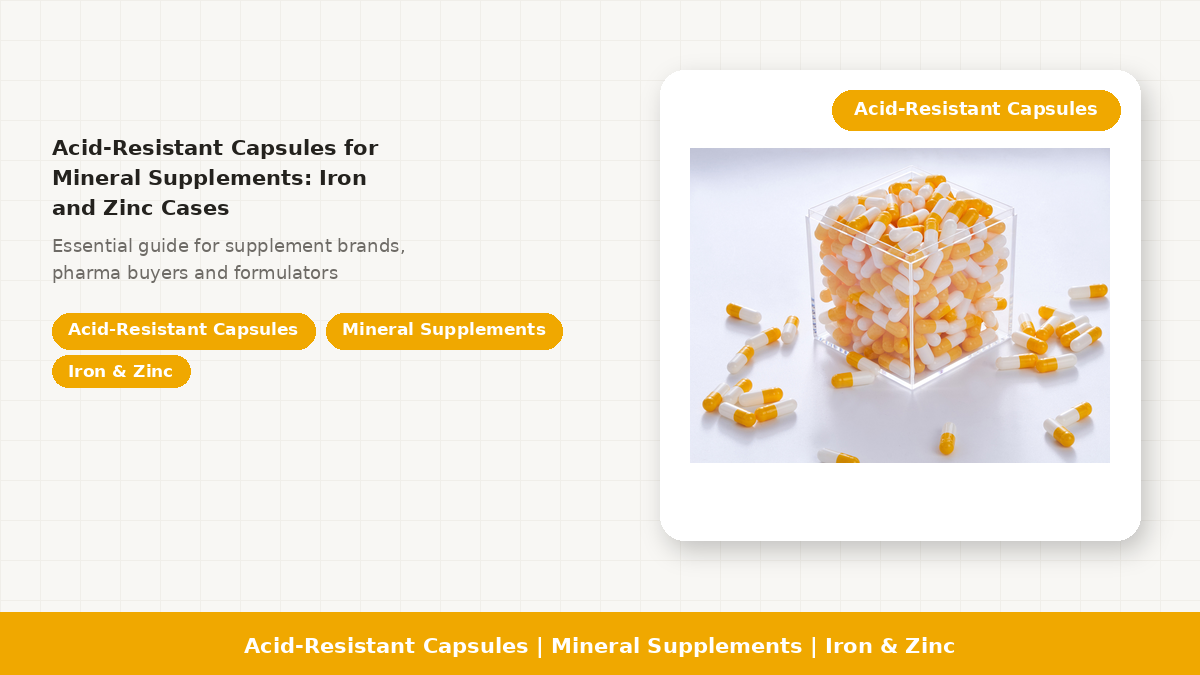
An acid resistant capsule is an empty shell that stays intact through gastric pH and opens in the intestine, and for iron and zinc that shell decides whether the mineral arrives intact and whether the label claim survives an audit. Because iron and zinc fail in different ways, one specification cannot cover both, and the formulation has to start from the behaviour of the mineral in the stomach rather than from a capsule catalogue.
TL;DR — What a Buyer Needs to Know
- Acid resistant enteric shells stay intact at stomach pH of 1.2 to 3.5 and dissolve at intestinal pH of 6.0 or above, and that release behaviour is the whole technical difference from a standard hard capsule.
- Iron and zinc are not the same case. Iron is an acid stability and oxidation problem, while zinc is a tolerability and dosing schedule problem, and the two need different shell targets and validation evidence.
- Validation follows USP <724>, where the acid stage runs 2 hours in 0.1 N hydrochloric acid at 37 ± 0.5 degrees Celsius and no single unit may exceed 10 % released before the buffer stage begins.
- Shancy's own programme reports a 2024 global enteric capsule market of 8.4 billion US dollars, a 7.8 % compound annual growth rate through 2030, more than 60 % of mineral supplement brands adopting enteric protection, and buyers in over 120 countries.
- Platform choice now decides procurement as much as chemistry does, because plant based HPMC enteric, TiO2-free and pullulan oxygen barrier shells each answer a different buyer requirement.
Iron is the harder case, because ferrous salts are the least stable of the common mineral actives, and zinc is mostly a tolerability case, because zinc gluconate and zinc picolinate are comparatively stable while the elemental dose is what customers complain about. That single distinction decides whether the shell is a stability requirement or a comfort requirement, and it decides which validation data the brand should ask for before the formula is locked.
Our enteric capsule range covers the shell platforms and the development route, our acid resistant capsule programme for mineral supplement packaging covers the iron and zinc use cases in detail, and the contact page is where a specification discussion starts.
What acid resistant actually means for a mineral fill
Acid resistance is a release behaviour, not a material name, and it is measured in two steps: the shell must not open in gastric conditions, and it must open in intestinal conditions on a defined schedule. Shancy's programme states the envelope: acid resistant shells remain intact at stomach pH of 1.2 to 3.5 and dissolve only at intestinal pH of 6.0 or above. The pharmacopoeial reference point is USP <724>, Drug Release — Delayed-Release (Enteric-Coated) Dosage Forms, which places one capsule in 0.1 N hydrochloric acid at 37 ± 0.5 degrees Celsius for 2 hours before the buffer stage, with no individual unit allowed to exceed 10 % released at the acid stage.

| Platform | Shell base | What it solves | Where it fits a mineral brief |
|---|---|---|---|
| Acid coated gelatin | Gelatin with an acid copolymer coating | Gastric protection on an established format | Brands locked to a gelatin line |
| Enteric HPMC | HPMC with a pH-dependent polymer coat | Plant based, vegan and halal positioning | Clean label mineral lines |
| Enteric pullulan | Fermented pullulan with an enteric coat | Acid resistance plus an oxygen barrier | Ferrous iron and oxidation prone zinc chelates |
| TiO2-free shell | Enteric shell without E171 pigment | Positioning after the EU E171 ban | EU-bound products where pigment is a question |
| High speed shell | Dimensional and moisture specification tuned to the filler | Line performance and weight control rather than chemistry | High volume runs on filling at 3,000 to 6,000 capsules per minute |
The platform decision is also a procurement decision, because each option carries a different certification chain into the destination market. A plant based HPMC shell answers a vegan or halal requirement that an acid coated gelatin shell cannot, a pullulan shell answers an oxidation requirement that HPMC does not, and a TiO2-free shell answers a European label question. That is why we scope the shell from the mineral and the market together rather than offering a default.
Why iron is the hard case
Iron fails in three separate ways at once, and an enteric shell only solves the first of them on its own. The first is acid hydrolysis of the ferrous salt, which is why ferrous salts are dosed with food rather than on an empty stomach. The second is oxidation, and Shancy's technical note identifies ferrous iron and certain zinc chelates as oxidation sensitive compounds that benefit from a shell with an enhanced oxygen barrier, which is the argument for a pullulan-based shell rather than an HPMC one. The third is commercial, because ferrous sulphate reacts with residual moisture and sulfur compounds in the shell to darken it, and a discoloured capsule is rejected at goods-in even when the fill is within specification.
| Failure mode | What the customer experiences | What the shell must deliver |
|---|---|---|
| Acid degradation of the ferrous salt | Reduced elemental iron delivered to the duodenum | No release below pH 6.0, and a demonstrated acid stage result |
| Oxidation during storage and filling | Metallic aftertaste, odour drift, shorter shelf life | An oxygen barrier matched to the fill |
| Darkening of the shell from ferrous fill | Rejected at goods-in, or a colour drift complaint | A shell and pigment that does not react with the fill |
| Gastric irritation and nausea | Customers stop taking the product | No direct gastric contact, fill delivered as one unit |
| Interaction with other actives in the same pack | Iron and zinc competing for absorption together | Separate units that can be scheduled apart |
That last row is where the iron case stops being purely a chemistry problem. An iron and zinc product is often sold as one daily dose, and an enteric capsule does not solve the competition between the two minerals, it only makes the timing controllable, so the schedule has to be designed rather than assumed.
Why zinc is a different case
Zinc is comparatively stable in gastric acid, so the enteric argument for zinc is not protection from degradation but protection from the consumer. Zinc gluconate and zinc picolinate tolerate gastric pH far better than ferrous salts do, and the recurring complaint on zinc products is nausea and a metallic taste when the dose hits an empty stomach. That makes zinc a tolerability case rather than a stability case, which changes the specification in a practical way: the shell still has to pass the same acid stage, but the release point that matters is the one that keeps the dose away from gastric contact, and the elemental dose per unit becomes the dominant variable.
| Question | Iron case | Zinc case |
|---|---|---|
| Primary reason to go enteric | Protect the active from gastric acid and oxidation | Reduce gastric irritation and aftertaste |
| Shell material priority | Oxygen barrier and colour stability | Clean label and dietary positioning |
| Release threshold to specify | As late as practical | As early as practical |
| Main commercial risk | Shelf life and colour drift in the pack | Elemental dose and daily limit claims |
| Question the buyer should ask the supplier | What does the shell do for oxidation and discolouration? | What is the gastric release profile, and how is the dose split? |
The honest conclusion is that iron justifies a more demanding shell specification and zinc justifies a more carefully designed dose and schedule, and a supplier who quotes the same release threshold for both has not answered either case. The buyer has to defend the label claim and the stability file in the same conversation.
How an enteric mineral capsule is validated
Five stages, and they run in this order because each one is the input to the next.
- Define the release specification before the shell is chosen. The acid stage behaviour, the buffer stage release point and the time window are written down as a target.
- Run the acid stage as USP <724> describes it. One capsule in 0.1 N hydrochloric acid at 37 ± 0.5 degrees Celsius for 2 hours, then the buffer stage, with no individual unit exceeding 10 % released.
- Confirm the buffer stage against the mineral, not against the capsule. The assay belongs to the payload and the release profile belongs to the shell.
- Test the filled product, not the empty shell. A shell that passes alone proves nothing about a ferrous fill, because the fill changes the moisture, weight and colour of the finished capsule.
- Close the regulatory file on the destination market. For the United States, 21 CFR Part 111 is the current good manufacturing practice rule for dietary supplements and requires identity, purity, strength and composition controls, and the certificate chain has to match the market.
| Data item | Acceptance basis | Why the buyer needs it |
|---|---|---|
| Acid stage result | No unit above 10 % released in 0.1 N HCl at 2 hours | Evidence the shell resists gastric conditions |
| Buffer stage release point | Release at a defined pH within a stated time window | Evidence the dose reaches the intended segment |
| Shell moisture specification | Declared range at the chosen size | Drives fill weight control and, with ferrous iron, colour |
| Fill weight and assay | Elemental iron or zinc per filled capsule | The number the label claim is written against |
| Stability on the filled product | Finished capsule over the declared shelf life | Proves shell and fill hold together for the claim period |
For a United States buyer, the method reference and the specification travel together. The FDA maintains a public Dissolution Methods Database for products with established methods, and a new enteric mineral product builds its own method on the <724> framework rather than borrowing another fill's monograph.
Where the market is heading
The demand side of this category is being pulled by the same trends that reshaped the rest of the capsule market. Shancy's programme reports a global enteric capsule market of 8.4 billion US dollars on a 2024 estimate, a projected compound annual growth rate of 7.8 % through 2030, more than 60 % of mineral supplement brands adopting enteric protection, and buyers served in more than 120 countries. Those are the publisher's own figures on its own product page, and we quote them as such.
Three platform shifts are worth tracking. Plant based enteric HPMC is replacing gelatin wherever vegan, halal or kosher positioning is required. TiO2-free shells are spreading after the EU ban on titanium dioxide in food applications. And pullulan enteric shells are specified where the fill is ferrous iron or an oxidation prone zinc chelate, because oxygen barrier is the requirement HPMC does not meet.
Frequently asked questions about acid resistant capsules
Are enteric capsules actually suitable for iron and zinc supplements?
Yes, and for two different reasons. Iron needs the protection because ferrous salts are the least stable of the common mineral actives at stomach pH of 1.2 to 3.5, and zinc benefits because a shell releasing at intestinal pH of 6.0 or above keeps the dose away from direct gastric contact, where the nausea complaints come from.
What is the actual difference between an acid resistant capsule and a standard hard capsule?
The difference is entirely in release behaviour. A standard gelatin or HPMC hard capsule opens wherever the product lands, while an enteric capsule stays intact at stomach pH of 1.2 to 3.5 and dissolves only at intestinal pH of 6.0 or above. Everything else, from size range to filling behaviour, stays familiar.
How do I verify that a capsule is really acid resistant?
Ask for the USP <724> acid stage result on the filled product: one capsule in 0.1 N hydrochloric acid at 37 ± 0.5 degrees Celsius for 2 hours, with no individual unit exceeding 10 % released. A certificate on the empty shell does not close the question, because the fill changes the release behaviour.
Can one enteric capsule carry both iron and zinc, or should they be separated?
They can be filled together, and many brands do it because a single daily dose is easier to take, but iron and zinc compete for absorption when released at the same moment in the same segment. If your claims depend on separating the two minerals, the safer route is two filled units rather than one combined fill.
What documents should I ask for before placing an enteric capsule order?
Ask for the release specification with its test conditions, the shell moisture specification at your chosen size, the certification chain for your destination market including GMP and any DMF or HALAL requirement, and stability data on the filled capsule over the shelf life you claim. For a United States launch, 21 CFR Part 111 sets the frame for identity, purity, strength and composition controls.
Where to start
If you are working on an iron or zinc line right now, the fastest route is to bring us the active, the elemental dose per unit, the target capsule size, the destination market and the shelf life you need to claim, and let the specification be written before the shell is chosen. We come back with the platform options that fit, the release specification we would propose and the test plan behind it. The useful conversation here is about your formula and not about a catalogue, so the fastest first step is a specification discussion, and it costs nothing to start one.
Related Resources from Shancy
- Enteric capsules — plant based HPMC enteric, TiO2-free and high-transparency fermented pullulan.
- Acid resistant capsules for mineral supplement packaging — the iron and zinc cases, the release envelope and the platform data.
- Contact Shancy — send the active, the elemental dose, the size, the market and the shelf life, and we return the platform options.