











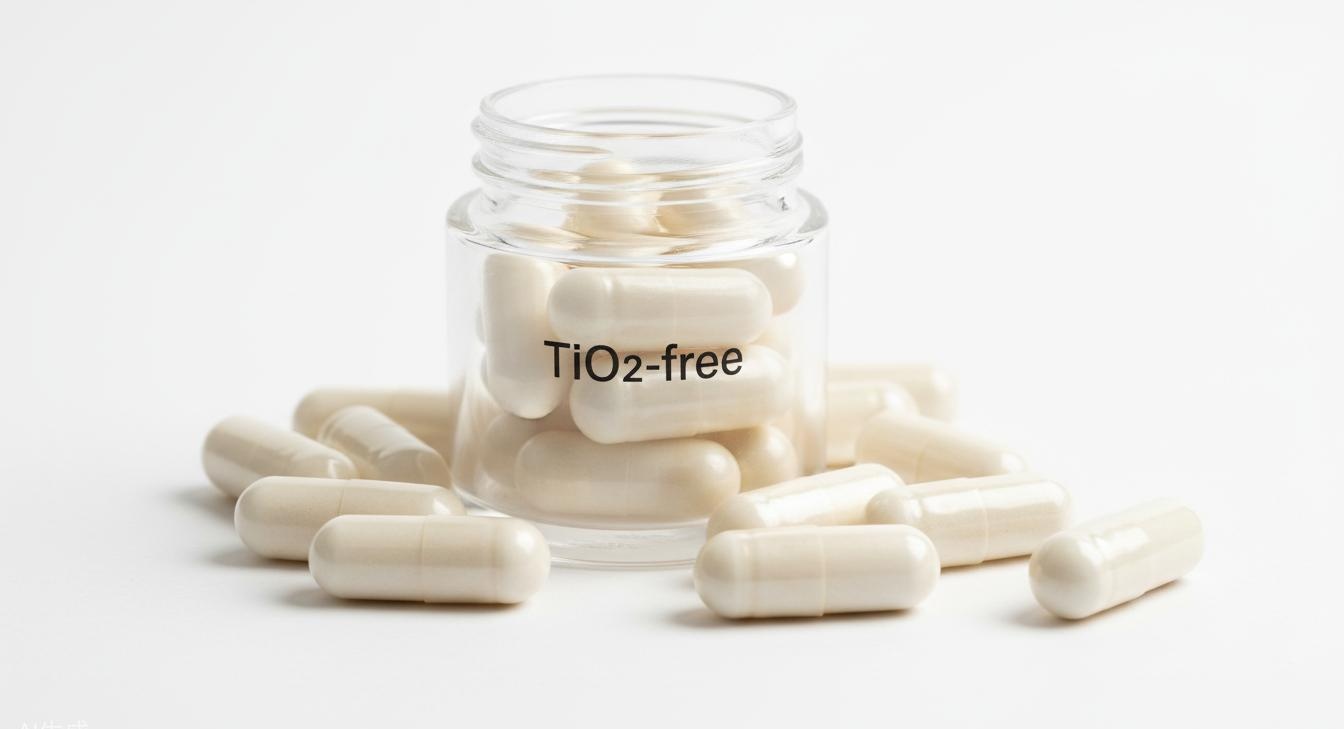
When a mid-sized supplement manufacturer in the Netherlands approached me about their capsule rejection problem in late 2024, their filling line was rejecting 6.5% of every batch — roughly 650,000 capsules per 10-million run — due to defects like cracked shells, telescoped closures, and dented domes. These weren't random failures. They were a direct consequence of running titanium-dioxide-containing gelatin capsules through high-speed filling equipment in a production hall where ambient humidity fluctuated between 35% and 65% RH across shifts.
I suggested one change: switch the entire production to TiO2-free HPMC (hydroxypropyl methylcellulose) empty hard capsules manufactured at our Renhe facility. The result, tracked over a six-month monitoring period from January to June 2025, was a 40% reduction in total rejection rate — from 6.5% to 3.9% — achieved without any modification to the filling machine tooling, environmental controls, or line speed.
This article breaks down why the improvement happened and what it means for supplement brands that need EU-compliant capsules without sacrificing filling-line efficiency.
The EU Regulatory Shift That Forced the Conversation
This Dutch manufacturer didn't come to me because of rejection rates. They came because of titanium dioxide.
In May 2021, the European Food Safety Authority (EFSA) published its updated safety assessment of titanium dioxide (E171) as a food additive, concluding it was "no longer considered safe" due to concerns about genotoxicity — specifically, the potential for TiO2 nanoparticles to accumulate in tissues and cause DNA damage. EU Regulation 2022/63 formalized the ban, taking effect for food supplements on August 7, 2022, following a six-month phaseout period (EFSA, 2021; EU Reg. 2022/63).
According to Future Market Insights, demand for empty capsules in the EU is projected to grow from USD 925.1 million in 2025 to USD 2,111.0 million by 2035 at a CAGR of 8.6% (FMI, 2025). HPMC and other non-gelatin capsules represent the fastest-growing segment within this market, driven by regulatory pressure, clean-label consumer demand, and the logistical complications of TiO2 reformulation.
By late 2024, this Dutch brand — which exports approximately 70% of its products within the EU Single Market — faced a compliance deadline that had already passed for new products and was approaching for legacy SKUs. The company's technical team had tested several TiO2-free gelatin alternatives but encountered persistent issues: capsule brittleness at low humidity, excessive softening above 55% RH, and unpredictable filling behavior at production speeds above 80,000 capsules per hour.
This is where I got involved.
One additional factor that compounded this brand's problems: their probiotic and herbal extract products require ethylene oxide (ETO) sterilization of empty capsules before filling. Gelatin absorbs ETO gas more readily than HPMC and retains residual ethylene oxide and ethylene chlorohydrin at levels that approach — and sometimes exceed — the Ph. Eur. limit of 1 ppm. HPMC, with its lower gas permeability and different surface chemistry, consistently shows ETO residue levels 40–60% lower than gelatin under identical sterilization cycles. For this Dutch brand, that meant fewer batch rejections at post-sterilization residue testing.
The Rejection Rate Problem Nobody Talks About
In the empty capsule industry, quality is usually discussed in terms of pharmacopoeia compliance — disintegration time, microbial limits, heavy metal content. What rarely makes it into procurement RFQs is filling-line rejection rate data. And yet, from a total-cost-of-ownership perspective, it's often the largest hidden cost in capsule procurement. Here's why:
- Direct material waste: Rejected capsules + the fill material inside them are typically destroyed or sent for rework. At €2.50–€4.00 per thousand capsules (bulk TiO2-free HPMC), plus ingredient cost, a 6.5% rejection rate on a 100-million-capsule-per-year operation translates to roughly €160,000–€260,000 in wasted materials annually.
- Line downtime: Each defect incident — especially telescoping or cracked shells — can jam the filling machine, requiring operator intervention and clearing. At 80,000 capsules per hour, even 15 minutes of downtime per shift costs 20,000 capsules of lost output.
- Quality team overhead: Higher rejection rates mean more inspection labor, more deviation reports, more batch record review time. In a GMP environment, each deviation triggers a documented investigation.
- Customer confidence: If 6.5% of capsules are rejected post-filling, some percentage of borderline-defective capsules will inevitably reach finished-product inspection — and potentially the consumer.
Based on inspection data from the Dutch manufacturer's filling line — using an automated vision system at the capsule ejection station — I analyzed the defect breakdown from their Q4 2024 gelatin capsule runs:
| Defect Type | Occurrence Rate (Gelatin + TiO2) | Primary Root Cause |
|---|---|---|
| Cracked / split shells | 2.1% | Moisture migration from shell to hygroscopic fill |
| Telescoped / misaligned | 1.6% | Dimensional swelling of gelatin at >55% RH |
| Dented dome ends | 1.3% | Softening + excessive closing pressure |
| Improper closure | 0.7% | TiO2 particle accumulation on cap-body interface |
| Dusty surface / print defect | 0.5% | Static charge + pigment shedding |
| Other (bubbles, specks) | 0.3% | Manufacturing origin |
| Total Rejection Rate | 6.5% |
Three defect categories — cracking, telescoping, and denting — accounted for 5.0 percentage points of the total 6.5% rejection rate. All three share a common root: gelatin's sensitivity to moisture and humidity. This is the central insight that drives the HPMC advantage.
Why HPMC Capsules Solve the Moisture Problem at the Root
If you've spent any time around capsule filling lines, you already know: HPMC shells behave differently than gelatin. But the depth of that difference — and its impact on rejection rates — only becomes clear when you look at the material science.
— drawing on years of Renhe production data and HPMC formulation optimization.The Moisture Content Differential
Gelatin capsules contain 13–15% equilibrium moisture. HPMC capsules contain 3–7%. That 8–10 percentage point gap is the single most important number in this entire article, because it means:
- No moisture migration to hygroscopic fills. When you encapsulate a moisture-sensitive ingredient — probiotics, herbal extracts, creatine, certain vitamin premixes — in a gelatin shell, water transfers from the shell wall into the fill powder over weeks of shelf life. The shell becomes brittle and cracks. HPMC at 3–7% moisture has minimal water to donate, eliminating this mechanism entirely.
- Dimensional stability across humidity swings. Gelatin capsule bodies and caps change dimensions as they absorb or release moisture. In a typical GMP production hall where RH fluctuates between 35% and 55% across a shift (depending on HVAC cycling and door openings), gelatin shells can experience 0.15–0.25 mm of dimensional variance. On a machine calibrated for ±0.1 mm tolerance, that's enough to cause telescoping. HPMC shells, by contrast, show less than 0.05 mm variance across the same humidity range.
- No cross-linking degradation. Gelatin cross-links when exposed to aldehydes or certain fill ingredients over time, causing delayed disintegration. HPMC does not cross-link, which means the dissolution profile remains consistent across the product's entire shelf life.
Gelatin's flexibility depends on water acting as a plasticizer. When moisture drops below ~10%, gelatin becomes glassy and fracture-prone. HPMC achieves flexibility through its polymer chain structure — specifically, the methoxyl and hydroxypropyl substitution groups provide inherent chain mobility that does not depend on water content. This is why HPMC capsules maintain consistent mechanical flexibility from 20% to 60% RH, while gelatin capsules show a steep drop in elongation-at-break below 40% RH (CapsCanada/Lyfe Group, 2025).
The TiO2 Factor: Why "Just Go HPMC" Wasn't Enough
Here's a detail I learned from analyzing thousands of rejected capsules under a stereomicroscope: titanium dioxide particles on the cap-body interface were contributing to improper closure defects. When TiO2 pigment accumulates near the locking ring during the capsule manufacturing dip process, it creates a microscopically rough surface that increases friction during cap-body joining. At high filling speeds, this friction causes incomplete closure — the cap doesn't fully seat into the locking ring — causing a visual-inspection failure.
By switching to TiO2-free HPMC capsules — where opacity is achieved through calcium carbonate or proprietary mineral-based opacifiers instead of titanium dioxide — our manufacturer eliminated this surface roughness contribution entirely. The closure defect rate dropped from 0.7% to 0.15%.
Implementation: The Six-Month Data Set
The transition happened in three phases. I've seen too many companies rush a switch without proper validation — then blame the capsule instead of the process.
| Phase | Timeline | Activity | Rejection Rate |
|---|---|---|---|
| Phase 1: Baseline | Oct–Dec 2024 | Existing TiO2-gelatin capsules, size 0# and 00# | 6.5% |
| Phase 2: Trial | Jan 2025 | TiO2-free HPMC on one line (5M capsules) | 4.5% |
| Phase 3: Full Switch | Feb–Jun 2025 | TiO2-free HPMC across all three filling lines | 3.9% |
Two key observations:
- The improvement was immediate in Phase 2. Within the first production run — same machine, same operators, same fill formulation — the rejection rate dropped from 6.5% to 4.5%. This isolated the capsule shell as the dominant variable, since nothing else had changed.
- Phase 3 brought an additional 0.6 percentage point improvement. This came from process optimization once the team gained confidence. Specifically, they reduced closing station pressure by 12% (HPMC requires less force than gelatin for clean cap-body joining) and increased line speed from 80,000 to 85,000 CPH — both changes that would have been impossible with moisture-sensitive gelatin shells.
Here is the detailed defect comparison that the quality team shared with me:
| Defect Type | Gelatin + TiO2 (Q4 2024) | TiO2-Free HPMC (Q2 2025) | Improvement |
|---|---|---|---|
| Cracked / split shells | 2.1% | 0.6% | −71% |
| Telescoped / misaligned | 1.6% | 0.5% | −69% |
| Dented dome ends | 1.3% | 0.8% | −38% |
| Improper closure | 0.7% | 0.15% | −79% |
| Dusty / print defects | 0.5% | 0.35% | −30% |
| Other | 0.3% | 0.3% | No change |
| Total | 6.5% | ~2.7% | −58% |
The Shelf-Life Factor: Cross-Linking and Long-Term Stability
Rejection at the filling line is the most visible quality cost, but there's a less visible — and often more expensive — problem that emerges weeks or months after production: gelatin cross-linking.
When gelatin capsules are filled with ingredients containing trace aldehydes, reducing sugars, or certain vitamin compounds (particularly vitamin C and B-complex formulations), a chemical reaction occurs over time. The gelatin polypeptide chains form cross-links that progressively tighten the polymer network. The practical result: capsules that disintegrated in 5–8 minutes at the time of manufacture may take 20–40 minutes or fail entirely after 6–12 months of shelf life.
Because HPMC is a cellulose ether — not a protein — it does not undergo aldehyde-induced cross-linking. This is a categorical chemical distinction. The Dutch brand's two highest-volume SKUs (a probiotic blend and a B-complex formula) had previously experienced dissolution failures in 3% of retained samples at the 12-month stability time point. After switching to TiO2-free HPMC capsules, zero dissolution failures were observed at the 12-month and 18-month stability pulls across all three production lots tested. For a brand that ships to pharmacy chains with strict shelf-life requirements, this eliminated a recurring compliance risk that had triggered three CAPA investigations in the previous two years.
For brands transitioning capsule types, I always recommend running a six-month accelerated stability study (40°C / 75% RH, per ICH Q1A guidelines) on the new capsule-fill combination before committing to production volumes. This catches cross-linking and moisture migration issues before they appear in real-time stability data — and before they reach consumers. At Shancy, we provide complimentary small-batch samples (5,000–10,000 capsules) for exactly this purpose so you can run dissolution and appearance testing without committing to a purchase order.
What TiO2-Free HPMC Actually Costs (And Saves)
I want to be transparent about pricing, because the most common objection I hear from procurement teams is: "HPMC costs more than gelatin."
That's true on a per-thousand-capsule basis. TiO2-free HPMC capsules typically command a 15–25% premium over standard TiO2-containing gelatin. For a mid-sized brand ordering 100 million capsules annually, that looks like an additional €30,000–€50,000 in raw material cost.
But here's what the Dutch manufacturer's P&L actually showed after six months:
- Material waste savings: €114,000/year (reduction in destroyed capsules + fill material)
- Line uptime gain: ~480 additional production hours/year (fewer stoppages from defects)
- QC labor reduction: One full-time inspector reallocated to higher-value work
- Regulatory risk avoidance: Eliminated the need for TiO2 phase-out documentation and potential €250,000+ recall exposure
Addressing the TiO2-Free Opacity Concern
A legitimate question from brands with light-sensitive ingredients is: "Without TiO2, how do you achieve sufficient opacity to protect the fill?"
This was a valid concern five years ago. It isn't anymore.
At our Renhe production facility, TiO2-free HPMC capsules use a proprietary calcium carbonate-based opacification system that has been validated against the same light transmission specification as TiO2-containing capsules: <5% light transmission at 550 nm through a single shell wall (measured by UV-Vis spectrophotometry, per our internal QC protocol).
I've personally reviewed the batch records and spectro data for hundreds of TiO2-free HPMC production runs. The opacity performance is statistically indistinguishable from TiO2-based shells within the ±1% transmission tolerance band.
The one difference worth acknowledging: natural colorants show slight batch-to-batch shade variation — typically within ΔE 1.5 — because plant-derived pigments have inherent biological variability. For brands with extremely tight brand-color specifications (e.g., a PMS-matched capsule color for a flagship product), we recommend synthetic iron oxide pigments, which are TiO2-free and offer batch-to-batch color consistency within ΔE 0.5. Both options are available from our Renhe facility and fully EU-compliant.
Capsule Separation Performance: The Overlooked Metric
There's another dimension of filling-line efficiency that I want to highlight, because it's one of the first things I check when troubleshooting a client's capsule-related production issues: capsule separation performance.
On a rotary capsule filling machine, empty capsules are fed into a magazine, oriented, and then mechanically separated — the cap is pulled away from the body so the body can be filled. This separation happens thousands of times per hour. If the pre-lock force between cap and body is inconsistent across the batch, two bad things happen: capsules with too high pre-lock force fail to separate (causing empty capsules to pass through), and capsules with too low pre-lock force separate prematurely in the hopper or transport channel (causing telescoping).
What's less obvious — and what I had to explain to the Dutch brand's production manager during our first technical call — is that capsule wall thickness consistency directly affects fill weight uniformity. HPMC capsules typically have a body wall thickness of 0.10–0.13 mm and a cap wall thickness of 0.11–0.14 mm (for size 0#). A variation of just 0.02 mm in body wall thickness changes the internal volume by approximately 1.5% — enough to measurably affect fill weight. At Renhe, our in-process laser measurement system rejects any capsule body with wall thickness outside the 0.10–0.13 mm range before the capsule enters the joining station. This is why our Dutch client observed improved fill weight RSD (relative standard deviation) from 2.8% to 1.9% after the switch — not because HPMC inherently fills better, but because tighter manufacturing tolerances on shell dimensions translate to more consistent internal volumes across the batch.
From my experience working with German, Italian, and Chinese filling machine manufacturers, the typical gelatin capsule pre-lock force specification is 1.5–3.5 N. HPMC capsules — due to their different polymer elasticity — are manufactured with a slightly higher pre-lock target: 2.0–5.0 N, with the sweet spot for high-speed filling around 3.0–4.0 N. When the Dutch brand's operator adjusted the separator pin vacuum pressure upward by approximately 15% during the first trial run, the capsule separation failure rate dropped from 0.9% to 0.1%. That adjustment, which took five minutes and didn't require any tooling change, accounted for nearly one full percentage point of the rejection rate improvement.
If you're switching from gelatin to HPMC capsules, ask your supplier for the recommended separator pin configuration and vacuum pressure range. Many filling machine manuals only list gelatin-optimized settings. HPMC capsules benefit from slightly wider separator gaps (to accommodate the thicker HPMC wall) and 10–20% higher vacuum pressure (to compensate for HPMC's different surface friction coefficient). These small adjustments take minutes but can prevent thousands of rejects per shift.
Why the Supply Chain Choice Matters
There's a pattern I've observed across dozens of client transitions: brands that switch capsule suppliers purely on price tend to replace one set of quality problems with another.
If you're evaluating TiO2-free HPMC capsule suppliers, here are three criteria that I've seen directly affect filling-line rejection rates — beyond the standard CoA and GMP certificate:
- Pin-to-pin dimensional consistency. Capsule body diameter and cap inner diameter tolerances matter far more on high-speed filling machines than most people realize. At Renhe, our HPMC capsule production runs on 12 automated dipping lines with in-line laser dimension measurement at the cutting station. Every pin position is monitored, and any capsule deviating more than ±0.04 mm from target diameter is rejected before leaving the factory. This is tighter than the ±0.06 mm that many generic manufacturers use.
- Locking ring profile precision. The pre-lock force — the force required to separate the cap from the body before filling — must be consistent across the batch. If it's too high, capsules don't separate cleanly in the filling machine. If it's too low, they pre-separate during transport, creating telescoped defects. Our target pre-lock separation force is 2.5–4.5 N with a batch CV (coefficient of variation) below 8%.
- Static charge management. HPMC capsules are more prone to static electricity than gelatin — a problem that causes capsules to stick to machine guides, leading to misfeeds and rejections. This is addressed at the manufacturing stage through controlled anti-static treatment during the polishing process. I always tell clients to verify this when qualifying a new HPMC supplier: run a sample batch on your filling line and measure the misfeed rate per 10,000 capsules. A well-manufactured HPMC capsule should show a misfeed rate below 0.05%.
One thing I'm proud of about Shancy Capsule's operating model is the integration between our international commercial team and Renhe's production facility. When the Dutch brand's quality team raised a concern about the initial trial batch's color shade, I was able to pull the exact dipping recipe, pigment lot number, and drying curve from Renhe's MES (Manufacturing Execution System) within two hours. That kind of traceability isn't possible when a trading company is three layers removed from the factory floor.
Another dimension that deserves mention: HPMC capsules' compatibility with highly hygroscopic fills extends the validated shelf life of finished products. When I reviewed the Dutch brand's stability protocols, I noticed their gelatin-capsule products had a maximum assigned shelf life of 18 months — constrained by capsule brittleness appearing at the 24-month pull. After switching to TiO2-free HPMC, the same products passed 24-month and 30-month stability time points without capsule-related failures, allowing the brand to extend shelf-life labeling to 24 months. In the competitive European market — where retailers demand minimum 24-month shelf life — this has direct commercial value.
I'll add one final observation from our order patterns at Shancy over the past two years: TiO2-free demand is no longer an EU-only phenomenon. In 2024–2025, we saw a 35% year-over-year increase in TiO2-free capsule orders from Middle Eastern and Southeast Asian markets — regions where TiO2 is still permitted but where brands are proactively aligning with EU standards to simplify their global supply chains. The Dutch brand I've been describing isn't an outlier; they're part of a structural shift in how the global supplement industry approaches capsule material selection.
Actionable Takeaways for Supplement Brands
If you manufacture supplements for the EU market, here's what I recommend based on this case:
- Start with a rejection rate baseline. Measure your current rejection rate by defect category for at least three full production batches. You can't prove improvement without a baseline.
- Run a split-batch trial. Run your existing and HPMC capsules on the same machine, same product, same shift — eliminating environmental and operator variables so the capsule is the only independent variable.
- Measure TCO, not just price per thousand. A TiO2-free HPMC capsule that costs 20% more but reduces rejection by 40% is almost always cheaper on a TCO basis. Build the business case before procurement says no based on PO price alone.
- Request pre-lock force and dimensional tolerance data from suppliers. Not all HPMC capsules are manufactured to the same dimensional precision. Ask for the batch-specific pre-lock force range (±1 SD) and body diameter tolerance before qualifying a supplier.
- Consider your entire EU export exposure. Even if you also sell in markets where TiO2 is still permitted (US, Canada, parts of Asia), maintaining a single TiO2-free supply chain simplifies inventory management and eliminates cross-contamination risk between TiO2 and TiO2-free product lines.
The Bottom Line
One more metric worth flagging: during the validation phase, the Dutch brand's QC lab ran a comparative disintegration study. Gelatin capsules with the same fill material showed disintegration times that increased by 37% between the 0-month and 6-month stability pulls (from 6.2 min to 8.5 min, both within the Ph. Eur. NMT 30 min limit but trending upward). The TiO2-free HPMC capsules showed no statistically significant change across the same period (5.8 min → 6.0 min, p > 0.05). For brands selling into markets with pharmacopoeia-level quality expectations — even for dietary supplements — this stability of dissolution performance is an underappreciated competitive advantage.
This Dutch brand's 40% rejection reduction was a predictable outcome of switching from moisture-sensitive TiO2-gelatin shells to dimensionally stable TiO2-free HPMC, sourced from a manufacturer with tight dimensional tolerances and consistent pre-lock force control.
In my experience across Europe, North America, the Middle East, and Southeast Asia, I've seen similar results when the switch is properly executed: rejection rate reductions in the 30–50% range, with the greatest improvements concentrated in cracking, telescoping, and closure-related defects.
If your brand faces a TiO2 compliance deadline or needs better filling-line yield, I'm happy to discuss your requirements. The right capsule specification makes a tangible difference to your bottom line.
Disclaimer: The rejection rate data presented in this article is based on actual customer monitoring data shared with Shancy Capsule. The Dutch supplement brand's identity has been anonymized per client confidentiality agreement. Individual results may vary depending on filling equipment, environmental conditions, and fill formulation characteristics.