
TL;DR
- Cross-linking is a chemical reaction, not a mechanical defect: aldehydes and tannins in green tea, grape seed, and Pueraria extracts form covalent bonds with gelatin, so the shell becomes permanently insoluble and disintegration time fails.
- Hydroxypropyl methylcellulose (HPMC) capsules are chemically inert because the shell contains no amino acids, so they eliminate the cross-linking reaction entirely rather than slowing it down.
- Our HPMC shells carry a moisture content of 4.0%-7.0% and remain flexible down to 2% relative humidity, which is why they protect hygroscopic spray-dried botanical powders instead of embrittling them.
- Shell moisture must be matched to fill moisture: a shell that is too dry pulls water out of the extract, and a shell that is too wet promotes mold, so both limits need to be agreed in writing before the first order.
- Always request batch-level disintegration data under ICH Q1A(R2) conditions, because a supplier who cannot show you a 6-month accelerated result will not be able to show you a 3-year shelf life.
HPMC capsules are the correct shell for herbal extract formulations whenever the extract contains tannins, aldehydes, or spray-dried hygroscopic carriers, because HPMC is a cellulose ether that contains no amino acids and therefore cannot form the covalent aldehyde or peptide bonds that cross-link gelatin. I have watched this exact problem arrive in our inbox as a complaint about a product that passed every test at release, and I have yet to see it solved by changing anything except the shell. Cross-linking is the single most common root cause of herbal capsules that pass every test at filling and then fail at 12 months: the shell does not break down, disintegration time exceeds the pharmacopoeial limit, and the active botanical stays trapped inside a capsule that looks perfectly normal.
The mechanism is specific. Cross-linking occurs because tannins and aldehydes in botanical extracts react with the amino groups in gelatin protein, so the two materials form permanent covalent bonds that make the shell insoluble in gastric fluid. When I sit down with a new customer and their extract specification, this is the first thing I look for. Green tea, grape seed, Pueraria, and several Ayurvedic extracts are the usual offenders. The extract is not "bad" and the capsule is not "defective" at filling; the reaction simply accelerates with heat and humidity in transit, which means a capsule that disintegrates in 12 minutes at our factory can still be intact at 24 months in a container shipped through a tropical port.
Hydroxypropyl methylcellulose, abbreviated HPMC and also known as hypromellose, is a plant-derived cellulose ether whose shell forms through a different chemistry that has no free amino groups. Because HPMC shells do not react with tannins or aldehydes, their disintegration profile stays consistent across the 3-to-5-year shelf lives typical of botanical supplements. When we supply an established HPMC empty capsule manufacturer relationship, what I mean is that your batch data, moisture limits, and certification files come from a supplier who already works under GMP conditions rather than from a trading intermediary.
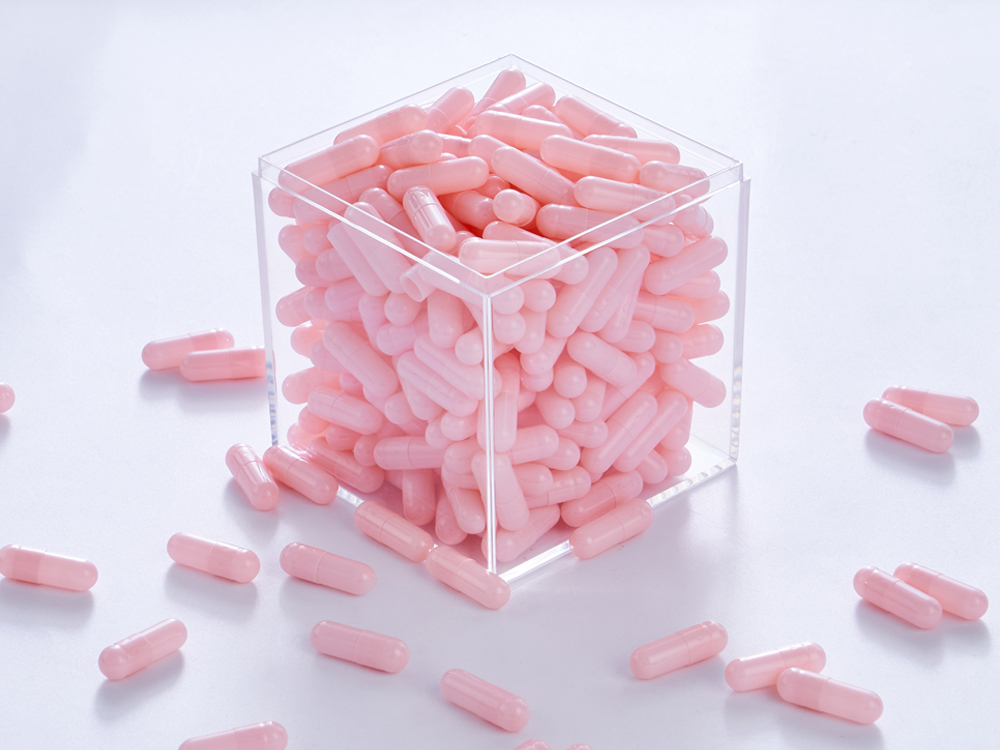
What Is Cross-Linking in Capsule Shells, and Why Does It Destroy Herbal Products?
Cross-linking is the irreversible chemical bonding of extract compounds to the capsule shell polymer, and it causes the failure because the bonded shell can no longer dissolve or swell enough to release its fill in the stomach. I have opened enough capsules from returned stock to know that this failure is invisible until you put one in a disintegration basket. Because the shell stays intact, the botanical actives pass through the gastrointestinal tract without being absorbed, and the consumer ends up paying for an expensive capsule with no effect at all.
The chemistry runs through amino groups. Gelatin is a protein, so its chains carry free amino residues that act as reaction sites. Tannins are polyphenolic compounds that are highly reactive toward those residues, and reducing aldehydes generated during extract processing can form Schiff-base-type bonds with the same sites. The result is a denser, cross-linked network across the shell wall, and once that network forms I have no way to break it.
Because the failure develops gradually, the first visible symptom is disintegration time rather than appearance. I cannot tell you how many capsules we have received back that looked perfect, passed the assay, and still failed the moment they hit water. The capsule looks normal, the fill weight is correct, and the assay passes on finished-product testing. Only when you run a disintegration test at 6 or 12 months does the number move.
Not every botanical extract triggers this, and I check before I quote anything. Common high-risk actives include green tea extract, grape seed extract, Pueraria lobata, bearberry, and several tannin-rich Ayurvedic formulations. If your extract falls in that group, shell chemistry stops being a packaging decision and becomes a product requirement.
Because cross-linking cannot be reversed once it occurs, so the shell must be selected before the first kilogram is filled rather than after the failure appears on a stability report. I have no coating or additive to offer you that restores an already cross-linked shell to its original dissolution behavior. There genuinely is not one.
It is worth being precise about what happens in the stomach, because the terminology gets confused in supplier conversations. Disintegration is the shell breaking apart, while dissolution is the fill going into solution, and cross-linking attacks the first step badly enough that the second never really begins. This distinction matters when a supplier quotes you a dissolution figure, because a shell that cannot disintegrate has no meaningful dissolution profile to report.
HPMC vs Gelatin for Herbal Extracts: A Comparison of Five Failure Modes
HPMC outperforms gelatin for tannin-rich and hygroscopic herbal extracts on five measurable dimensions, because the absence of protein in the shell removes cross-linking risk entirely and the cellulosic wall tolerates a wider humidity band than gelatin. Gelatin remains cheaper and dissolves faster in simple matrices, so I still specify it for non-reactive, low-humidity fills without hesitation.
| Evaluation dimension | Hard gelatin capsule | HPMC capsule |
|---|---|---|
| Cross-linking risk with tannin and aldehyde-bearing extracts | High, because free amino groups react with tannins to form insoluble covalent bonds. | None, because the cellulose ether shell contains no amino acids to react with. |
| Shell moisture content | Typically 13.0%-17.0% to stay flexible, which is difficult in dry climates. | Typically 4.0%-7.0%, which protects hygroscopic fills instead of feeding them. |
| Behavior at low relative humidity | Becomes brittle and cracks on the filling line, raising breakage rates. | Stays flexible down to 2% relative humidity without embrittling. |
| Consumer dietary positioning | Excludes Vegan, Halal, and Kosher markets because it is an animal-derived protein. | Suitable for Vegan, Halal, and Kosher positioning because it is wood-pulp derived. |
| Light protection | Requires opaque colorants, and opaque colorants historically relied on titanium dioxide. | Available in opaque colors using mineral-based opacifiers instead of titanium dioxide. |
Because the HPMC shell costs more per capsule than standard gelatin, primarily because it is made from refined wood pulp through a multi-stage etherification process, it is only the correct purchase when your extract chemistry actually requires it. That is why I would not put an ashwagandha or ginseng extract in HPMC by default; both are comparatively well-behaved in gelatin, and the additional cost does not buy measurable stability. I have had customers ask me to convert a perfectly stable gelatin line to HPMC because of a trend, and I talk them out of it every time.
Why Do Botanical Extracts Lose Stability Inside Capsule Shells?
Herbal extracts lose stability in capsules mainly through moisture migration, oxidation, and light exposure, because a spray-dried extract is hygroscopic by design and because the shell wall changes its own moisture equilibrium with the fill it encloses. Stability loss is separate from cross-linking, but in our experience the two often arrive in the same quarter, which is why both must be addressed at sourcing rather than at troubleshooting.
Spray drying converts a botanical liquid extract into a free-flowing powder by adding carriers such as maltodextrin or silicon dioxide. That carrier is what makes the powder hygroscopic, and at intermediate relative humidity it will absorb enough water to cake, harden, and reduce flowability. Once the powder cakes, weight variation on the filling line increases, and I have watched a batch that was perfectly cohesive at the hopper spread by 15% in fill weight by the time it reached the closing station.
There is a second mechanism that surprises buyers, and it is the one that catches me out every time a customer assumes the bottle is protecting the fill. A shell that is drier than its fill will pull moisture out of the extract to reach equilibrium, and moisture migration inside the capsule continues regardless of what the outer bottle humidity is doing.
Because moisture redistribution happens inside the sealed capsule, so a hermetic outer package cannot prevent it, the only real control is choosing a shell whose moisture content sits in the same band as your fill. This is the single most important question to ask a supplier, and it is the one most often left unasked.
Oxidation is the second pathway. Polyphenols, essential oil fractions, and lipid-soluble extracts degrade with oxygen exposure, and because capsule filling is done at high speed with open transfer, headspace oxygen in the finished bottle matters more than many formulators expect. When I review a new artwork file, that headspace number is one of the first things I ask for.
Light is the third. Transparent capsules on a retail shelf are exposed to light for months, and chlorophyll-bearing and polyphenol-rich extracts are the most sensitive to it. I would rather see an opaque shell and a short shipping route than a clear shell and a good stability argument.
8 Sourcing Criteria for HPMC Capsules in Botanical Formulations
The eight criteria that actually separate a qualified HPMC capsule supplier from a trading middleman are documented shell moisture control, batch-level disintegration evidence, protein-free raw material sourcing, defined size range, machine-compatibility support, and third-party certification coverage. I have learned to spot the difference quickly, because a supplier who answers all eight in writing is sourcing real material, while a supplier who answers only price is sourcing for somebody else.
- Request the shell moisture specification in writing, with a tolerance range. A responsible supplier will state a controlled band such as 4.0%-7.0% and a method reference, rather than answering "about 5%." If I get "about 5%" I keep asking, because that answer tells me the band is not controlled.
- Ask for batch-level disintegration results under ICH Q1A(R2) stability conditions. Release testing proves only the fresh batch. Stability testing under ICH stability guidance is what proves your three-year shelf life claim, and I will not supply against a certificate that shows release testing only.
- Confirm the raw material is protein-free and derived from wood pulp rather than animal tissue. This single question eliminates most cross-linking risk and simultaneously validates your Vegan claim. I would put it at the top of your questionnaire.
- Check whether the shell stays flexible at low relative humidity. Shells that become brittle below a certain humidity will crack on high-speed filling lines and in dry warehouse air, which shows up as a yield loss you did not budget for. Our HPMC shells hold together down to 2% relative humidity.
- Verify the available size range against your target fill weight. Botanical capsules typically run from size 000 down to size 4, and the wrong size creates a powder volume that no machine can fill cleanly. I match this to your powder density, not just your target weight, because those are different numbers.
- Ask whether the supplier supports filling-machine setup consultation. Shell mechanics, join strength, and compression tolerance all change with humidity, and a supplier who visits your line saves you a trial batch. We do this because the alternative is a trial batch on your dime.
- Confirm certifications for your destination market before ordering. Vegan, Halal, and Kosher requirements are common for botanical lines sold into the EU, Middle East, and North America respectively. I ask for the destination in the first email because retrofitting certification later costs you a print run.
- Ask to see the traceability statement for raw material sourcing. Shell material from a documented sustainable plant source is increasingly a requirement for retail buyers, not a nice-to-have. I would put this near the top of your list too.
Because all eight criteria can be answered in a single technical questionnaire, any supplier that requires a deposit before returning the answers is telling you the answers do not exist. I send the questionnaire with the first inquiry, and I expect it back before I quote anything. When I do not get it back, that is usually where the conversation ends.
How Do You Match Shell Moisture to Fill Moisture?
Shell moisture must be specified within a controlled band that brackets your fill moisture without exceeding it, because the capsule will always equilibrate toward the wetter component and an out-of-band shell changes fill flowability and potency stability. This matching is the most practical stability control available to a formulator who cannot modify the extract itself, and I would argue it matters more than most people expect.
The logic is simple and directional, and I have walked at least a hundred formulators through it. If your extract has a low equilibrium moisture content, a high-moisture shell will feed it water, promote caking, and raise the risk of microbial challenge in the finished product. If your extract is highly hygroscopic, an aggressively low-moisture shell will pull water out of it and can concentrate degradation reactions at the shell interface.
There is a second, mechanical reason to care. Shell moisture affects join strength. In our experience with high-speed botanical lines, an HPMC shell that has been conditioned too dry produces a brittle seam, and the seam fails first because it is the thinnest part of the closed capsule. I have seen this on the line myself, and no amount of adjusting the tamping pressure fixes it once the shell is out of spec.
Because shell moisture is a process variable rather than a fixed property, the correct approach is to agree a target band with your supplier at specification stage and then verify it on every incoming batch rather than trusting the certificate alone. Certificates describe production, not your warehouse, and I check incoming lots against the agreed band before releasing them to the line.
One more point worth stating plainly: humidity during storage affects the shell, the fill, and the machine in different ways, which is why I insist on a single setpoint defined for the whole line rather than each element tuned separately. Nobody in the plant wants to own three different humidity numbers.
How Do You Verify Disintegration Performance Before You Commit to a Supply Contract?
You verify capsule performance by running a stability-indicating disintegration study on the filled capsule, because the empty shell test tells you very little about how the finished product will behave after the extract is inside. Shell-only disintegration is a raw material check; the filled capsule is what your customer experiences, and that is the test I care about.
The recommendation I give to every botanical customer is a defined sequence. First, run disintegration on the empty shell so you have a baseline for the material itself. Second, fill the capsule with your actual extract and run it again, because the fill changes the swelling mechanics entirely.
Third, place filled capsules under accelerated stability conditions and re-test at each interval. The accepted framework for this work is documented in ICH quality guidelines, and I will not sign a supply agreement that skips it, because a supplier who cannot show six months of accelerated data will not be able to show you three years of shelf life.
Fourth, and this is the step most buyers skip, physically inspect the capsule after the interval. A shell that has become leathery, fused, or discolored tells you something that a numeric disintegration value does not. I ask for a photo every time, because words like "leathery" mean different things to different people.
Because disintegration failure is the earliest detectable symptom of cross-linking, running this test on your actual extract is cheaper than a field complaint about a product that no longer works. I would rather a customer run one extra test at the start than discover the problem in a stability report at month nine, and I have said this to more customers than I can count.
Make sure the test uses your real fill, your real machine settings, and your real storage condition. A capsule filled by hand under laboratory conditions tells you about the laboratory, not about your product, and I have seen expensive stability programs built on exactly that mistake.
Which Compliance Requirements Apply to Plant-Based Capsules by Market?
Compliance requirements for plant-based capsule shells differ mainly by destination market, because a shell sold into the EU must address food-additive rules while a shell sold into the United States must address current good manufacturing practice expectations for dietary supplements. Confirming the destination early prevents a certification gap that delays a launch, and I ask for it before I quote anything else.
For the United States, dietary supplement manufacturing is governed by 21 CFR Part 111, which covers current good manufacturing practice for manufacturing, packaging, labeling, and holding operations. That regulation is the correct reference for a supplier claiming cGMP compliance, and you should verify the claim against the actual regulation text rather than a marketing page.
For the European Union, the relevant questions are food-additive status, labeling requirements, and halal or vegan substantiation. If your formulation uses opacity for light protection, be aware that the EU food-additive rules for titanium dioxide have changed and mineral-based opacifiers are the usual replacement. When I review an EU-bound specification, the opacifier choice is a question I always raise.
For the Middle East, halal certification is typically mandatory rather than optional, and the shell, the colorants, and the manufacturing site all fall inside the audit scope. Exporters moving into this market usually confirm the certification route well before the print run, because a failed audit costs far more than a delayed order.
Because certification requirements are decided at formulation stage and cannot be retrofitted after a print run, the certification conversation must happen before you approve artwork, not after. Our team asks for the destination market in the first email precisely to avoid this, and I have seen a launch delayed four months because somebody assumed the certification was already in place.
The technical background on shell and extract interaction is well covered in the peer-reviewed literature, and searching capsule cross-linking with aldehydes and tannins on PubMed is the fastest way to review the mechanism before you brief a formulator.
You can find our current contact details and address at our contact page, and I am glad to answer specification questions directly if another supplier's documentation is unclear. That question costs you nothing, and I would rather you ask me than guess.
When Is Gelatin Still the Right Choice for an Herbal Extract?
Gelatin is still the right choice when the extract contains no tannins or aldehydes, when the fill is not hygroscopic, and when cost per unit is a binding constraint, because gelatin dissolves faster and costs less than HPMC in non-reactive matrices. Recommending HPMC for every botanical product would be poor engineering advice, and I have declined to do it even when it would have been easier for me commercially.
Good candidates for gelatin include simple lipid-soluble extracts, and many single-herb powders that are not spray-dried. If you are unsure, the test I give you is straightforward: look for a spray-dried extract with a carrier, and look for a tannin content in the specification.
There are situations where HPMC is the wrong choice, and I would rather say so than take the order. If you need a shell that dissolves within seconds for rapid absorption, standard gelatin may outperform standard HPMC. If your positioning explicitly claims animal-derived or bovine-derived sourcing, a plant shell contradicts your own label.
Because the capsule choice should follow the extract chemistry rather than follow the marketing trend, the honest answer to "which shell should I use" is a diagnostic question about your actives, not a house preference. If your extract is well-behaved, save the budget. If it is not, you do not have a price problem; you have a chemistry problem.
Which Capsule Should You Choose? A Decision Framework
Choose an HPMC capsule when your extract contains tannins, aldehydes, or spray-dried carriers and when the product must carry Vegan, Halal, or Kosher positioning, because HPMC removes the cross-linking reaction that gelatin cannot survive in those matrices.
Choose HPMC when:
- Your extract contains tannins, aldehydes, or polyphenolic concentrates. Green tea, grape seed, Pueraria, bearberry, and most spray-dried liquid extracts fall into this category, because the reactive compounds have nothing to bind to in a protein-free shell.
- Your fill is hygroscopic or cakes at intermediate humidity. A low-moisture shell avoids feeding the powder the water it is trying to absorb.
- You ship through hot or humid climates. Because HPMC shells stay flexible down to 2% relative humidity and do not embrittle, they survive both dry and humid distribution.
- You need Vegan, Halal, or Kosher certification. A wood-pulp-derived shell satisfies all three without a separate animal-origin argument.
- Your label must be titanium-dioxide-free. Opaque HPMC shells can use mineral-based opacifiers instead.
Choose gelatin when:
- Your extract has no tannin or aldehyde content. Simple single-herb powders and non-spray-dried materials are generally well-behaved in gelatin.
- You need very rapid dissolution for absorption reasons. Standard gelatin can outperform standard HPMC on dissolution speed in simple matrices.
- Cost per unit is the binding constraint. HPMC costs more per capsule, primarily because refined wood pulp requires multi-stage etherification.
- Your branding explicitly claims animal-derived sourcing. A plant shell would contradict your own label.
Because the cost difference between the two shells is meaningful at industrial volumes, the decision should be driven by extract chemistry rather than by capsule trend, so a diagnostic review of your actives is the correct first step before any quote is requested.
Frequently Asked Questions About HPMC Capsules for Herbal Extracts
What is the main difference between HPMC capsules and gelatin capsules for herbal extracts?
The primary difference is that HPMC capsules contain no amino acids, so tannins and aldehydes in botanical extracts cannot react with the shell. Gelatin is a protein with free amino groups, and those groups form permanent covalent bonds with reactive botanical compounds, which is what causes cross-linking. HPMC is a cellulose ether, so that reaction pathway simply does not exist. Beyond chemistry, HPMC also carries lower shell moisture at 4.0%-7.0% compared with the 13.0%-17.0% typical of gelatin, and it stays flexible down to 2% relative humidity instead of embrittling.
Can HPMC capsules be used for any herbal extract, or are there limitations?
HPMC capsules work across a very wide range of herbal extracts, including sprays, powders, and oils, but they are not the optimal choice for every application. They are the strongest option for tannin-rich, aldehyde-bearing, and hygroscopic formulations, and they are the only option when Vegan, Halal, or Kosher positioning is required. They can be less suitable when you need exceptionally rapid dissolution for absorption reasons, or when your branding explicitly claims animal-derived sourcing. The decision should follow your extract chemistry rather than a general house preference.
How does cross-linking affect the stability and efficacy of a herbal capsule?
Cross-linking makes the shell insoluble, so the capsule fails to disintegrate in the stomach and the botanical actives are not released. The consumer absorbs nothing, even though the capsule looks normal and the active assay passed at release. Because the reaction is gradual and driven by heat and humidity in transit, the failure typically appears at 6 to 12 months rather than immediately. This is why disintegration testing on your actual filled capsule, at each stability interval, is the earliest reliable detection method.
Is low-moisture HPMC better for hygroscopic herbal extracts?
Low-moisture HPMC is specifically better for hygroscopic extracts because a low-moisture shell does not act as an additional water reservoir for a powder that is already trying to absorb moisture from the air. Spray-dried extracts with carriers such as maltodextrin are hygroscopic by design, and a 13.0%-17.0% gelatin shell actively works against them. A shell specified in the 4.0%-7.0% band is closer to the fill equilibrium and helps the powder retain its flow properties through the filling line and through storage.
What shell moisture specification should I agree with my supplier?
You should agree a controlled band with a tolerance and a stated test method, then verify it on every incoming batch rather than trusting a certificate. The practical rule is that the shell band should bracket your fill moisture without exceeding it. If your extract has a low equilibrium moisture content, an overly wet shell will feed it water and promote caking, while an overly dry shell can pull water out of a highly hygroscopic fill. Our HPMC shells are typically supplied in a 4.0%-7.0% range, and we confirm the band against your specific fill before the first order.
Do HPMC capsules meet Vegan, Halal, and Kosher requirements?
Yes, because HPMC capsules are derived from wood pulp rather than animal tissue, so they carry no animal-origin requirement. This is one of the main commercial reasons herbal brands move from gelatin to HPMC, since a single shell change can open the EU, Middle East, and vegan retail channels at once. Halal certification is typically mandatory for Middle East distribution rather than optional, and it covers the shell, the colorants, and the manufacturing site together, so it should be arranged at formulation stage.
How do I verify that a capsule will still work at 24 months?
You verify it with a stability-indicating disintegration study on the filled capsule, following ICH stability guidance for accelerated conditions, and re-testing at each interval. Shell-only testing is a raw material check and tells you very little about the finished product. I also recommend physically inspecting the capsules after each interval, because a shell that has turned leathery, fused, or discoloured reveals something that a numeric disintegration value alone can hide. Any supplier who cannot show you accelerated data should not be signing a multi-year supply agreement.
What capsule sizes are available for botanical formulations?
Our HPMC capsules are supplied from size 000 down to size 4, which covers the fill-weight range most botanical products use, and they are available in transparent and opaque colors. The size decision is driven by powder volume rather than actives weight, because a hygroscopic extract can occupy considerably more volume than its weight suggests. If you are sizing for a first production run, send us your target fill weight and target potency and we will confirm which size your filling line handles cleanly.
Working on a botanical formulation with tannin-rich or hygroscopic extracts? Send us your extract description, target fill weight, and destination market, and we will come back with a shell specification, a moisture band matched to your fill, and the certification files relevant to your target region. You can reach our export team directly through our contact page, or browse our full HPMC capsule range to see which format fits your line.