











Oxygen Barrier Comparison: Pullulan vs HPMC vs Gelatin OTR Data
TL;DR — What the Numbers Actually Say
- Pullulan's oxygen barrier is roughly 300 times that of HPMC, and the reason is structural rather than chemical: pullulan is a dense, hydrogen-bonded polysaccharide that was never chemically modified, so molecules cannot pass through it easily.
- That 300x figure is a film property, not a shelf-life claim. The governing test standard, ASTM D3985, states in its own Scope section that OTR is an important determinant of barrier performance but is not the sole determinant, and that additional tests must be used to correlate performance with OTR.
- Moisture content is a separate variable from OTR, and for many actives it dominates. Gelatin typically carries 13 to 15 percent moisture, HPMC 4 to 6 percent, pullulan 5 to 8 percent, and for hygroscopic actives the lower-moisture shell is the more important barrier.
- There are two oxygen paths into a filled capsule, not one. Permeation through the shell wall is a material property; permeation down the overlap between cap and body is a mechanical property of the capsule. A shell with excellent OTR and a poor seal still delivers oxidised product.
- The practical rule: pullulan for oxidation-sensitive actives in premium clean-label formats, HPMC for hygroscopic and moisture-sensitive fills where low moisture matters more than oxygen, gelatin where cost and dissolution speed dominate and the active is not oxygen-sensitive.
Who this is for: formulators and brand owners specifying hard capsule delivery for oxidation-sensitive ingredients — vitamins C and E, essential oil powders, premium probiotics, botanical extracts — and importers who need to evaluate a capsule supplier's barrier claims rather than accept them. To see the full Shancy pullulan capsule range and the premium pullulan empty capsule specification, or contact our team for OTR test data on your target size and film thickness.
Start With the Test, Not the Claim
Most oxygen barrier conversations in the capsule industry begin with a number, and that is the wrong place to begin. They begin with a number because the number is quotable, and the quotable number is usually a film property measured under laboratory conditions, and the gap between a film property and a filled product on a retail shelf is where most of the disappointment lives.
The standard that governs this measurement is ASTM D3985, Standard Test Method for Oxygen Gas Transmission Rate Through Plastic Film and Sheeting Using a Coulometric Sensor. The current edition is D3985-24. The test itself is sound: a film specimen is clamped in a diffusion cell, oxygen is swept across one side, and the permeation rate through the film is measured coulometrically. It is a referee method, and it is the reference against which other OTR methods are compared.
But the Scope section of the standard itself carries the caveat that this entire article is built around, and it is worth quoting directly because almost nobody quotes it: "The OTR is an important determinant of the packaging protection afforded by barrier materials. It is not, however, the sole determinant, and additional tests, based on experience, must be used to correlate packaging performance with OTR."
So let me work backwards from the standard rather than forwards from the marketing. Three materials, three different molecular architectures, three different barrier behaviours — and then the variables that OTR leaves out.
Why the Three Materials Behave So Differently
The barrier differences between pullulan, HPMC and gelatin are not a matter of formulation or grade. They are structural consequences of what each polymer is and how it was made, and once you understand the structure the performance ranking is predictable.
Pullulan: dense, unmodified, hydrogen-bonded
Pullulan is a linear polysaccharide produced by natural fermentation of starch by the fungus Aureobasidium pullulans. It is a linear glucan with a repeating maltotriose unit, and the defining feature for barrier purposes is that it is not chemically modified. There is no substituent, no ether bridge, no plasticiser chain interrupting the hydrogen-bonding network between adjacent chains.
That network is what does the work. In a dense hydrogen-bonded polysaccharide matrix, the free volume available for a small gas molecule to diffuse through is small, and the polar hydroxyl groups interact favourably with the polar oxygen molecule, which slows its passage further. The published commercial claim for our premium pullulan empty capsules is an oxygen barrier approximately 300 times more effective than HPMC, and the structural reason for that order of magnitude is exactly this: a chemically unmodified polysaccharide network against a chemically modified cellulose ether.
Two further properties fall out of the same structure, and they matter as much as the OTR in practice. Because pullulan is not protein-based, it cannot undergo the Maillard-type cross-linking that gelatin undergoes, which is why our pullulan shells are described as extremely stable, will not cross-link, and maintain consistent dissolution over time. And because the film is chemically unmodified, it is free of starch, gluten and preservatives, which is what makes it the natural choice for organic-certified and clean-label brands.
HPMC: chemically modified cellulose ether, engineered for moisture
HPMC, or hypromellose, is a cellulose ether produced from wood pulp through a chemical modification step that introduces a hydroxypropyl substituent and methyl groups along the cellulose chain. The substitution does two things: it makes the polymer soluble where native cellulose is not, and it breaks up the native hydrogen-bonding network.
That network break is the key to understanding HPMC's barrier profile. Because the substituted cellulose chain has more free volume than unmodified pullulan, oxygen permeates it more readily, and the commercial comparison of roughly 300 times the barrier of HPMC is a direct consequence of that difference in free volume rather than a difference in quality.
What HPMC is genuinely excellent at is moisture. Its shells are toughened to withstand the mechanical stress of automated filling pins and hoppers, they are chemically inert, they contain no amino acids, and they do not become brittle in low humidity down to as low as 2 percent relative humidity. For a hygroscopic powder or a moisture-sensitive API, a low-moisture shell at 4.0 to 7.0 percent moisture content that will not cross-link and will not embrittle is often the more valuable property, even though its oxygen barrier is weaker.
HPMC also provides a neutral container that effectively masks the strong scents of certain botanical extracts, and it is the safe vehicle for mineral salts and amino acids that are incompatible with gelatin.
Gelatin: protein, excellent moisture, weakest oxygen barrier
Gelatin is the protein fraction of collagen, and our GMP-certified empty hard gelatin capsules are made from pharmaceutical-grade bovine or porcine gelatin, non-GMO and BSE/TSE-free, in standard sizes 000 through 5.
Gelatin carries the highest residual moisture of the three, typically 13 to 15 percent, and it is a protein, which means it is hygroscopic, chemically reactive with many actives, and subject to cross-linking when exposed to trace moisture. Because gelatin is the most permeable of the three shells to both oxygen and water vapour, and because it is also the fastest to dissolve and the lowest in cost, it is the right choice exactly when the active is not oxygen-sensitive and speed and economics matter more than protection.
Its genuine strengths are mechanical and commercial: low water activity and tight sealing, compatibility with most powder, granule and semi-solid formulations without cross-reactivity, precision engineering for both manual fillers and high-speed automated machines, and a long-established regulatory file.
The Comparison, Side by Side
Here is the three-way comparison with the variables that a barrier discussion normally omits, in the order a formulator would actually work through them.
| Property | Pullulan | HPMC | Gelatin |
|---|---|---|---|
| Origin | Natural fermentation of starch | Wood pulp, chemically modified cellulose ether | Pharmaceutical-grade bovine or porcine collagen |
| Chemical modification | None | Substituted, hydroxypropyl and methyl groups | Hydrolysis and denaturation of collagen |
| Relative oxygen barrier | Best of the three — approximately 300x HPMC | Moderate | Weakest of the three |
| Residual shell moisture | 5 to 8 percent | 4.0 to 7.0 percent — lowest | 13 to 15 percent — highest |
| Behaviour at low humidity | Remains stable | Does not become brittle down to 2 percent RH | Becomes brittle and loses sealing integrity |
| Cross-linking risk | None — not protein-based | None — no amino acids | Significant — protein-based cross-linking |
| Dissolution | Rapid, pH-independent | Consistent throughout shelf life | Fastest |
| Vegan / clean label | Yes — free of starch, gluten, preservatives | Yes | No — animal-derived |
| Certifications typically needed | Non-GMO, Halal, Kosher, Organic-compliant | Non-GMO, Halal, Kosher | Halal, Kosher, BSE/TSE-free, DMF |
| Size range | 00# to 4# | Standard range | 000 to 5 |
| Best fit | Vitamins C and E, essential oil powders, premium probiotics, organic-certified lines | Hygroscopic powders, moisture-sensitive APIs, herbal extracts, probiotics | Traditional formats, non-sensitive actives, cost-sensitive volume |
One line in that table deserves emphasis because it is the one that gets missed most often. Because gelatin is protein-based and pullulan and HPMC are not, cross-linking is a gelatin-specific failure mode, and cross-linking is what turns a capsule that dissolves cleanly into one that sits intact in a patient's stomach for an hour. That is a failure of the shell's mechanical behaviour, not of its barrier performance, and it is invisible in an OTR number.
The Four Variables OTR Does Not Capture
This is the section I would want a buyer to read before they accept a barrier comparison from anyone, including us. There are four variables that OTR leaves out, and each of them can independently cost a product its shelf life.
1. Residual moisture in the shell
We have covered this above and it is the single largest factor. Because a hygroscopic active inside a 13 to 15 percent moisture gelatin shell can pick up enough water during storage to hydrolyse, and because a hydrolysed active is a degraded active, the moisture content of the shell is a barrier question even when the active is not oxidation-sensitive. For hygroscopic powders, a low-moisture HPMC shell at 4.0 to 7.0 percent is frequently the correct answer even though its oxygen barrier is 300 times weaker.
2. The cap-to-body overlap
This is the one I would most want a buyer to raise with a supplier, because it is a mechanical property and mechanical properties are not measured by a gas permeation test. Because a two-piece capsule is sealed by the interference fit of the cap over the body, and because that joint is a mechanical path into the capsule, a shell with an outstanding OTR and a joint that does not seal will deliver a product that oxidises through the seam rather than through the wall.
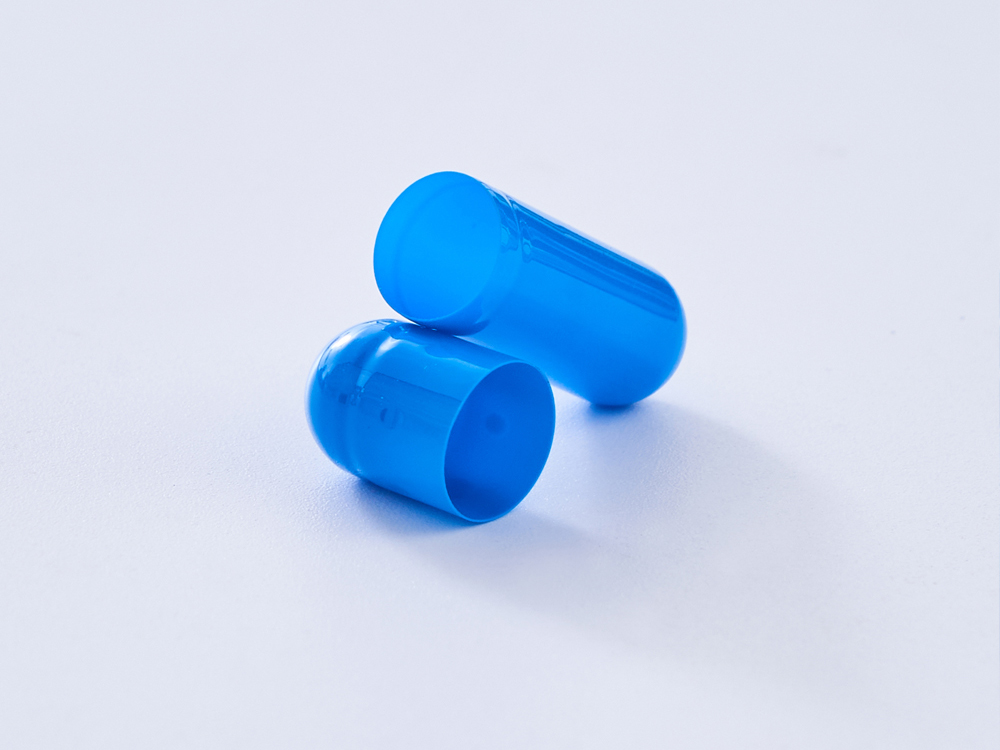
This is also why the photograph above shows an open capsule. The overlap length and the interference tolerance are visible there, and they are the parts of the capsule that determine whether the theoretical barrier becomes a real one. A supplier who cannot show you the overlap geometry for the size you are buying is asking you to assume it.
3. Wall thickness and the effect of the filling process
OTR is a property of a film of a given thickness, and capsule shell thickness is not a constant across sizes or across materials. Because a thicker wall lowers OTR roughly in inverse proportion while the film is the same material, and because the wall thickness a customer receives is set by the forming process and then affected by the mechanical stress of automated filling pins and hoppers, the OTR of the film as supplied is not the OTR of the capsule as filled.
The practical consequence is that a capsule supplier who quotes a film OTR without quoting the finished-capsule wall thickness has given you half the number, and the half they gave you is the flattering half.
4. Storage conditions along the distribution chain
OTR is measured under controlled temperature and humidity, and the distribution chain is not controlled. Because oxygen permeation through a polymer is strongly and non-linearly dependent on temperature, and because a container that crosses an ocean in a summer season or sits in a warehouse in a hot climate sees conditions that no laboratory test reproduces, the field performance of a barrier film is a different question from its measured OTR.
This is also the point at which a lower moisture shell earns its keep independently of oxygen, because a low-moisture shell is more forgiving of humidity excursion than a high-moisture protein shell, and a shell that has absorbed moisture is a shell whose sealing behaviour has changed.
Matching the Shell to the Active
Given all of the above, here is how the three materials map onto the ingredient classes in practice, using the applications we see most often across our vitamin, supplement and herbal extract customers.
| Active class | Recommended shell | Why |
|---|---|---|
| Vitamin C (ascorbic acid) | Pullulan | Highly susceptible to oxidation. The strongest available oxygen barrier plus pH-independent rapid release protects both potency and the consumer's experience of the product. |
| Vitamin E (tocopherol) | Pullulan | Susceptible to oxidation, and frequently formulated with vitamin C. The 300x barrier advantage is the primary reason to specify pullulan here. |
| Essential oil powders | Pullulan | Traps volatile aromatic compounds for longer potency. The high-gloss crystal-clear shell also supports the premium positioning these products sell on. |
| Premium probiotics | Pullulan | Provides an inert, airtight environment for sensitive cultures, and the shell is free of starch, gluten and preservatives, which suits a clean-label claim. |
| Organic-certified products | Pullulan | Produced via natural fermentation with no chemical modification, which is the natural choice for a brand with strict non-GMO and natural requirements. |
| Hygroscopic botanical extracts | HPMC | Low moisture content of 4.0 to 7.0 percent protects the fill, no amino acids means no cross-linking, and the neutral container masks strong botanical scents. The oxygen barrier is secondary here. |
| Moisture-sensitive APIs | HPMC | Chemically inert, does not embrittle below 2 percent RH, and maintains a consistent dissolution rate throughout shelf life. |
| Mineral salts and amino acids | HPMC | Explicitly safe where gelatin is not, because there is no protein present to react with the active. |
| Non-sensitive actives, cost-sensitive volume | Gelatin | Best mechanical performance on high-speed fillers, fastest dissolution, lowest cost, and the most established regulatory file including DMF and BSE/TSE-free status. |
Two patterns in that table are worth naming, because they are the ones that surprise buyers. Because pullulan combines the best oxygen barrier with rapid pH-independent disintegration, it is the only one of the three that is simultaneously a protection choice and a delivery-profile choice, which is why it is positioned as a premium option rather than a niche one.
And second, because HPMC does not become brittle in low humidity down to 2 percent relative humidity and does not cross-link, it is the safer shipping choice for hygroscopic products moving through climates that a gelatin capsule will not survive intact, and that is a logistics decision as much as a formulation one.
What to Ask a Capsule Supplier
Seven questions, and they are the questions we would want a buyer to put to any supplier including us. Because the OTR number is the part of the conversation that is easiest to quote and hardest to interpret, a buyer who has not asked the other six questions has not evaluated the barrier, they have just collected it.
- Which test method and which edition? ASTM D3985 and which year, and was the measurement on the film or on the finished capsule?
- What were the test conditions? Temperature, relative humidity, and the film thickness the figure was measured at. OTR at one thickness does not transfer to another.
- What is the finished capsule wall thickness for the size I am ordering, and is the OTR figure corrected for it?
- What is the overlap length and interference tolerance for the cap-to-body joint at my size?
- What is the residual moisture content of the shell as supplied, with a specification range rather than a typical value?
- What stability data do you have on a filled capsule containing an oxidation-sensitive active, in the package configuration I would ship?
- What certification documents accompany the material for my destination market — DMF, HALAL, KOSHER, Organic, and the food or dietary supplement regulatory route I am selling into?
Send the answers with the specification, not alongside it. Because a barrier argument that lives in an email thread rather than in the purchase order is a barrier argument that a receiving inspector cannot check, and a packaging specification that cannot be checked is a preference rather than a specification.
Regulatory Frame for the Destination Market
Because a capsule shell is a material in contact with a food or drug product, and because the destination market determines which declaration the shell must carry, the compliance question is a short one and it is not optional.
For the United States, empty drug capsules fall under 21 CFR Part 207, the regulation governing registration of manufacturers and distributors of certain human drugs, and a buyer importing into the US market should confirm that the manufacturing site and the DMF position are current for the specific product. For the European Union, the framework is Regulation (EU) 2015/228 on materials intended to come into contact with food, which is the route for dietary supplement shells sold into the EU. For a finished consumer product placed on the European market, the General Product Safety Regulation 2023/988 adds the traceability and economic-operator obligations that sit on top of the material rules.
And behind the material compliance sits the manufacturing system, which is where the barrier is actually protected during production. Because our pullulan capsules are produced in facilities following strict GMP protocols, with each lot tested for transparency, tensile strength and microbial limits, the barrier performance a customer receives is a property of a controlled process rather than of a purchased film, and the difference between the two shows up in lot-to-lot consistency.
One practical point that comes directly out of the pullulan mechanism and that we make to every customer. Because pullulan is a high-performance material with a dense hydrogen-bonded structure, we provide specialised storage and handling instructions to ensure the best results on your filling machines, and a capsule that has been stored incorrectly before filling is a barrier compromise that occurred before the OTR test was ever run.
Where This Leaves the Comparison
Let me be precise about what the data in this article does and does not establish, because the gap between the two is where a lot of money gets wasted.
What it establishes is a ranking, and the ranking is structural rather than incidental. Because pullulan is an unmodified hydrogen-bonded polysaccharide and HPMC is a substituted cellulose ether, and because gelatin is a protein, the oxygen barrier follows the free volume in the matrix, and that follows from the chemistry rather than from the grade or the supplier. If a supplier offers you a pullulan capsule and quotes a barrier advantage over HPMC, that advantage is structural and it will be present in every legitimate pullulan capsule you are ever handed.
What it does not establish is shelf life, and I want to be plain about that rather than let the table imply otherwise. Because the governing test standard states in its own Scope section that OTR is not the sole determinant of packaging protection and that additional tests are needed to correlate performance with OTR, any argument that runs from a barrier number straight to a shelf life claim is skipping a step that the standard itself says has to be taken.
What I would tell a formulator is this. Because the three materials differ in oxygen permeability, in residual moisture, in cross-linking behaviour, in humidity tolerance and in mechanical robustness, and because an oxidation-sensitive formula and a hygroscopic formula stress different subsets of those five properties, the correct shell is determined by which of your failure modes you are actually exposed to rather than by which material has the best number in the comparison table.
For a vitamin C line in a premium clean-label brand, pullulan wins on the primary failure mode and costs little in the secondary ones. For a hygroscopic herbal extract moving through a humid distribution chain, HPMC wins on the primary failure mode and costs a great deal in the secondary one, because the oxygen barrier gap is real. For a high-turnover line where the active is inert and the channel is price-led, gelatin is the right answer and no barrier argument should override it.
And the one thing I would ask you not to do is to treat this article as a substitute for your own stability study. Because a comparison table tells you which capsule to test, and a stability study on the filled product in the intended package tells you whether it works, and only the second one is evidence you can put in front of a customer, an auditor or a regulator.
FAQ — Oxygen Barrier and Hard Capsule Questions
How much better is the pullulan oxygen barrier than HPMC?
Our published figure for the premium pullulan empty capsule is an oxygen barrier approximately 300 times more effective than HPMC. The reason is structural: pullulan is a polysaccharide produced by natural fermentation of starch and is left chemically unmodified, so its dense hydrogen-bonded matrix leaves little free volume for an oxygen molecule to diffuse through. HPMC is a cellulose ether whose hydroxypropyl and methyl substituents interrupt that network, which is why the difference is an order of magnitude rather than a marginal improvement.
Which test method should I ask a capsule supplier to report?
ASTM D3985, the Standard Test Method for Oxygen Gas Transmission Rate Through Plastic Film and Sheeting Using a Coulometric Sensor, currently at the D3985-24 edition, is the reference method. Ask for the test conditions as well as the result — temperature, relative humidity and film thickness — because an OTR figure quoted without them cannot be compared against anything. ASTM F1929 is the companion method for humidity-sensitive barrier materials and is worth asking about where the fill is hygroscopic.
Does a low OTR number guarantee a long shelf life?
No, and the standard says so itself. The Scope section of ASTM D3985 states that the OTR is an important determinant of the packaging protection afforded by barrier materials, that it is not the sole determinant, and that additional tests based on experience must be used to correlate packaging performance with OTR. A low OTR is a necessary condition for good protection, not a sufficient one, because the cap-to-body overlap, the finished wall thickness, the residual moisture in the shell and the storage conditions along the distribution chain are all independent of the film measurement.
Which capsule has the lowest moisture content?
HPMC, at typically 4.0 to 7.0 percent residual moisture, against 5 to 8 percent for pullulan and 13 to 15 percent for gelatin. That makes HPMC the right choice for hygroscopic powders and moisture-sensitive APIs, and it is the reason an HPMC capsule does not become brittle in low humidity down to 2 percent relative humidity, which matters for shipping into dry climates.
What is cross-linking and which capsule materials are affected?
Cross-linking is a chemical reaction between a protein shell and trace moisture or aldehydes in the fill, and it progressively increases the molecular weight of the shell so it no longer dissolves cleanly. It is a gelatin-specific failure mode, because gelatin is a protein and pullulan and HPMC are not. HPMC contains no amino acids and pullulan is not protein-based, so both are free from it. A cross-linked capsule can look perfect and pass an OTR test while failing to dissolve in the intended time window.
Which shell is best for vitamin C and vitamin E?
Pullulan, for both. Vitamin C is among the most oxidation-sensitive actives in commercial supplement, and vitamin E oxidises readily as well and is frequently formulated alongside vitamin C. Pullulan delivers the strongest available oxygen barrier with rapid pH-independent disintegration, and it is produced via natural fermentation with no chemical modification, which suits a clean-label or organic-certified line. Where the same brand also carries hygroscopic botanicals, HPMC may still be the more robust choice for those SKUs, and a range covering both is a normal outcome.
Can pullulan capsules run on standard high-speed filling equipment?
Yes, and the shells are engineered for mechanical toughness on high-speed lines, but the material is high-performance and needs correct handling. Because pullulan is a dense, unmodified polysaccharide matrix, it is more sensitive to storage and handling conditions before filling than a conventional shell, and we provide specialised storage and handling instructions to ensure the best results on your filling machines. We also note that pullulan minimises powder adhesion on the shell surface during encapsulation, which reduces a common source of fill loss on high-speed lines.
What certifications do pullulan capsules carry?
We provide full certification documentation including Non-GMO, Halal, Kosher and Organic-compliant documentation. Pullulan capsules are available in sizes 00# to 4#, and every lot is tested for transparency, tensile strength and microbial limits under strict GMP protocols. For market access, the specific requirement depends on whether the finished product is a food, a dietary supplement or a drug, so tell us the destination market and we will return the documentation chain that applies.
Is gelatin still the right choice for a non-sensitive product?
Yes, and it would be poor judgement to talk a buyer out of it. Gelatin offers excellent stability, easy filling and smooth swallowing, is compatible with most powder, granule and semi-solid formulations without cross-reactivity, and is precision-engineered for both manual and high-speed automatic capsule fillers. It is also the best-documented and lowest-cost of the three, with a mature DMF and regulatory position. The correct use of a barrier comparison is to identify the SKUs where protection is the binding constraint, not to move a catalogue that does not need moving.
What should I send you to get OTR data for my product?
Send the active or ingredient class, the target capsule size, the fill weight, the destination market, the required certifications and your current filled-product shelf life. That is enough for us to return the relevant film OTR figure with its test conditions and film thickness, the finished-capsule wall thickness at that size, the residual moisture specification range for the shell, and the certification documents that apply to your market. You do not need a purchase order to get the data, and we would rather you tested a sample against your own formula than bought a quantity on our data alone.