











Private Label Empty Capsules: Building Your Own Shell Brand
Every month, a buyer emails me the same opening question: "We want to launch our own private label empty capsules brand — can you walk us through how it works?" The honest answer is that building a shell brand is one of the more accessible private-label programs in the supplement space, but it is not a "design a logo, place an order" project. The buyers who do it well treat the capsule as a regulated component, not a generic commodity, and they qualify the manufacturer before they design the artwork.
After years of running export programs for empty hard capsules — gelatin, HPMC, and pullulan — for pharmaceutical and dietary-supplement clients across North America, Europe, the Middle East, and Southeast Asia, I have watched the same pattern repeat across markets. The buyers who succeed make four deliberate decisions in order: choose the material that matches the formulation, qualify the manufacturer against the destination-market regulatory baseline, finalize the size and color palette against the target consumer, and then — only then — design the packaging artwork. The buyers who fail skip the first two steps and end up with a beautiful branded capsule that does not dissolve correctly, does not meet the regulatory standard for the destination market, or both. This article walks through what a disciplined private-label capsule program looks like, using the HPMC plant-based capsule line as the reference configuration.
- The first decision is the capsule material — gelatin, HPMC, or pullulan — and that decision is driven by the formulation, not by the buyer's preference.
- Regulatory positioning (DMF, GMP, HALAL, KOSHER, vegetarian) must be locked before artwork design.
- MOQ and lead time depend on the customization level — stock sizes and colors can ship from very small lots.
- The biggest first-time mistake is choosing the material first and the formulation second.
What Is a Private Label Empty Capsule, Exactly?
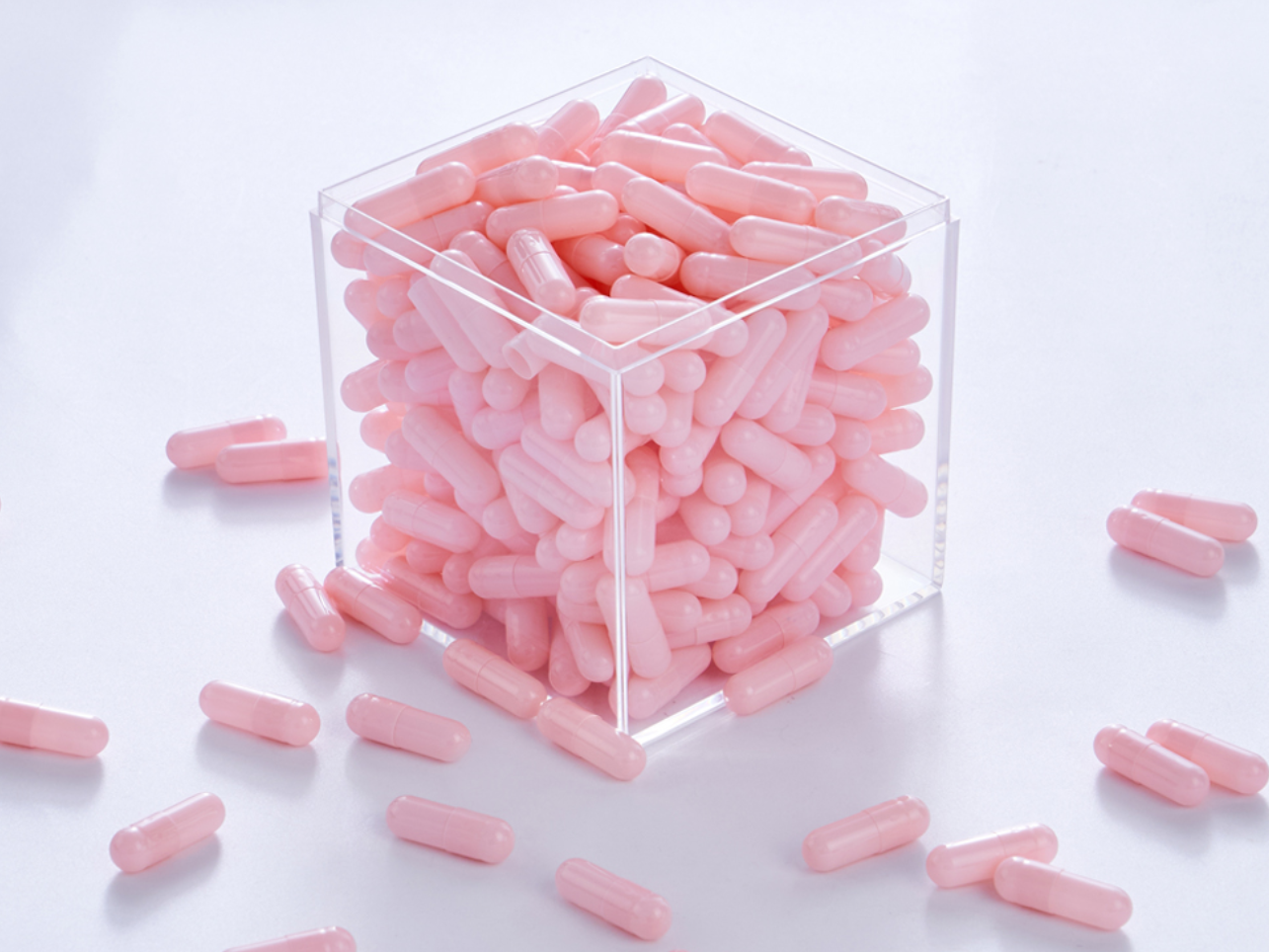
Walk into any supplement contract manufacturer and you will see two product formats side by side: finished capsules that the contract manufacturer fills and ships under the buyer's brand, and empty two-piece capsule shells that the buyer purchases in bulk and fills either in-house or at a separate co-packer. The private label empty capsule is the second format — the shells themselves, without any active ingredient inside.
The advantage of the empty-shell model is that the buyer controls the filling process, the formulation, and the brand presentation end to end. The disadvantage is that the buyer now owns the manufacturing responsibility for filling, which means owning the equipment, the cleanroom, the stability testing, and the regulatory documentation. Most private-label empty capsule buyers are either nutraceutical brands with their own filling line or contract packagers serving multiple brand owners.
For buyers who want to private label the capsule shell itself — printing the brand name or logo on the shell, not just on the packaging — the manufacturer needs to be set up for capsule printing. This is a separate capability from capsule manufacturing and not every supplier offers it.
Which Capsule Material Should You Choose?
The capsule material choice is the first technical decision, and it is the one that drives every subsequent decision. Three materials cover most private-label programs:
- Gelatin. The traditional two-piece capsule, made from bovine or porcine collagen. Lowest cost, widest range of available sizes and colors, decades of regulatory acceptance. The right answer for most cost-sensitive programs and for products where vegetarian or vegan positioning is not a marketing priority.
- HPMC (hydroxypropyl methylcellulose). Plant-based, made from cellulose. Vegetarian, vegan, kosher, halal by default. The right answer for clean-label positioning, for vegetarian and vegan consumer segments, and for retailers who require non-animal-derived ingredients. Dissolution characteristics are slightly different from gelatin, so formulation work has to be re-validated.
- Pullulan. Made from fermented tapioca. The premium plant-based option, often chosen for allergen-sensitive products, for clean-label claims, and for premium supplement lines. More expensive than HPMC and with a smaller supplier base.
| Material | Source | Consumer Positioning | Cost Position | Best For |
|---|---|---|---|---|
| Gelatin | Bovine / porcine collagen | Traditional | Lowest | Cost-sensitive programs |
| HPMC | Plant cellulose | Vegetarian / vegan | Mid-range | Clean-label retail brands |
| Pullulan | Fermented tapioca | Premium plant-based | Highest | Allergen-sensitive premium lines |
The reference configuration used throughout this guide is the HPMC plant-based capsule line, which has become the default material for most new private-label supplement launches because it satisfies vegetarian, vegan, kosher, and halal positioning in a single material choice. For pharmaceutical-grade programs, gelatin remains the dominant choice on cost and regulatory familiarity, but HPMC pharmaceutical-grade capsules are increasingly available for buyers who need a plant-based pharmaceutical format.
What Changes When You Switch Materials
The capsule material is not just a label claim — it changes the physical behavior of the shell and the fill. The four variables that move when the material changes are:
- Dissolution rate. HPMC capsules typically dissolve slightly slower than gelatin capsules in standard USP disintegration tests, which can matter for products with a tight dissolution window.
- Moisture sensitivity. HPMC capsules are slightly more moisture-sensitive than gelatin, which can be an issue for hygroscopic fills. Pullulan capsules are the most moisture-sensitive of the three.
- Shell brittleness. HPMC and pullulan shells are more brittle at very low humidity than gelatin, which can affect filling-line performance in dry climates.
- Lock geometry. Each material has a slightly different optimized locking geometry, which is why a capsule designed for gelatin does not always fill cleanly on the same filling machine when switched to HPMC.
What Certifications and Regulatory Documentation Should the Supplier Hold?
A private label empty capsules brand lives or dies by the documentation the supplier can hand over at audit. The right documentation set depends on the destination market, but the baseline is the same in every market. Five certifications are non-negotiable for a serious private-label program.
- GMP (cGMP) certification. Current Good Manufacturing Practice, aligned with FDA pharmaceutical cGMP expectations for empty capsules. The right answer is a recent GMP audit certificate issued by a recognized third-party auditor or by the destination-market regulator.
- Drug Master File (DMF). For pharmaceutical capsules sold into the U.S. market, the manufacturer should hold an active DMF on file with the FDA. The DMF is a confidential file that contains the manufacturing details, the quality control procedures, and the stability data. The buyer's regulatory dossier references the DMF by number.
- ISO 9001. Quality management system certification, required by most retail buyers as a baseline demonstration of process discipline.
- HALAL and KOSHER certification. For supplement products sold to consumer segments that require religious dietary certification, the capsule itself must carry the certification. The buyer cannot HALAL-certify the capsule downstream.
- Vegetarian / vegan certification. For plant-based capsule claims, a recognized vegetarian or vegan certification from a body such as the Vegan Society or a national vegetarian society adds retail credibility beyond the supplier's self-declaration.
For the U.S. regulatory baseline, the relevant authorities are codified in Title 21 of the U.S. Code of Federal Regulations, which governs food, drugs, cosmetics, and medical devices. For the EU pharmaceutical baseline, the relevant authority is EudraLex, the collection of EU pharmaceutical regulations published by the European Commission. For the excipient-grade quality and GMP framework that applies specifically to capsule shells, the most authoritative international reference is the International Pharmaceutical Excipients Council (IPEC) Federation, with regional implementation through IPEC Europe. For the audit framework that ties GMP and GDP together for excipient suppliers, EXCiPACT is the recognized industry standard.
| Certification | Required For | Issued By | Verification |
|---|---|---|---|
| GMP (cGMP) | All pharmaceutical / supplement markets | Recognized third-party auditor or regulator | Certificate copy + audit report on request |
| DMF (Type IV for excipient) | U.S. pharmaceutical market | FDA | DMF number referenced in buyer's regulatory dossier |
| ISO 9001 | Baseline quality management | Accredited certification body | Certificate copy, current and in scope |
| HALAL | Muslim-majority consumer markets | Recognized Islamic authority | Certificate copy, scope covers capsules |
| KOSHER | Kosher-observant consumer markets | Recognized rabbinical authority | Certificate copy, scope covers capsules |
| Vegan / Vegetarian | Plant-based consumer claims | Recognized vegetarian society | Certificate copy or registered trademark logo |
What About HALAL and KOSHER for the Capsule Itself?
The HALAL or KOSHER status of the capsule shell is a property of the raw material and the manufacturing process, not of the finished product. A gelatin capsule made from pork-derived collagen is not HALAL or KOSHER regardless of what the buyer puts inside. A gelatin capsule made from beef-derived collagen may be KOSHER (depending on the rabbinical authority) but is not HALAL. An HPMC capsule is HALAL and KOSHER by default because the raw material is plant-derived and the manufacturing process does not introduce animal-derived additives.
For buyers serving the Indonesian, Malaysian, Middle Eastern, or broader Muslim consumer market, the recognized HALAL authorities include MUI (Indonesian Ulema Council) for Indonesia and parallel authorities in other Muslim-majority markets. For KOSHER, the Orthodox Union (OU) is the most widely recognized certification body internationally.
How Do You Build the Private Label Program Step by Step?
The buyers who run the smoothest private label empty capsule programs follow a disciplined sequence. The four steps below are the ones that consistently produce a successful launch without last-minute rework.
- Step 1: Finalize the fill formulation. The buyer locks the formulation — active ingredient, excipients, particle size, fill weight — before any capsule specification is requested. The formulation determines the material, the size, the dissolution profile, and the stability testing plan.
- Step 2: Choose the capsule material and size. Based on the formulation's requirements and the consumer positioning, the buyer selects gelatin, HPMC, or pullulan, and selects the size that matches the target fill weight. Most supplement capsules are size 00, 0, 1, 2, or 3.
- Step 3: Qualify the manufacturer. The buyer audits the manufacturer's GMP certification, DMF status, HALAL and KOSHER certifications, and recent regulatory inspection history. The buyer requests reference samples and runs them through the buyer's own incoming-inspection program.
- Step 4: Finalize size, color, and packaging artwork. The buyer selects the size and color that match the target consumer segment, then designs the packaging artwork against the destination-market labeling regulations. The artwork is the last step, not the first.
For the broader consumer-product regulatory baseline that the artwork step has to satisfy — including labeling claims, supplement facts panels, and allergen declarations for the U.S. market — the most authoritative U.S. reference is the U.S. Code of Federal Regulations Title 21, and the FDA's compliance and enforcement program is the operational reference for what claims and what labeling are inspected.
What About Lead Time and MOQ?
Lead time and MOQ depend on the customization level. The four common scenarios, with typical ranges:
| Customization Level | Typical MOQ | Typical Lead Time | Tooling Required |
|---|---|---|---|
| Stock size, stock color, stock material | Small | Short | None |
| Stock size, custom color, stock material | Mid | Mid | Color matching |
| Custom size, stock or custom color | Higher | Longer | Size tooling + setup |
| Fully custom size and color, custom material blend | High | Longest | Full tooling + validation |
The right MOQ question to ask the supplier is not "what is your MOQ" but "what is your MOQ at the unit price you are quoting" — the two answers can be very different. A supplier that quotes an aggressive unit price may require a production batch that is larger than the buyer's actual demand. The right comparison is the unit price at the buyer's actual order size.
What Mistakes Do First-Time Private Label Buyers Most Often Make?
Three mistakes repeatedly catch even experienced brand owners when they are launching their first private label empty capsules program. None of them are exotic; they are the questions that don't get asked until the program is already in flight.
- Choosing the material first and the formulation second. A buyer who falls in love with HPMC as a marketing story and then has to reformulate a hygroscopic probiotic to fit HPMC's moisture profile has spent more on reformulation than the marketing claim was worth. The right sequence is formulation first, material second.
- Skipping the manufacturer audit. A buyer who takes a supplier's GMP certificate at face value without verifying the audit date, the certifying body, and the scope of certification may be shipping under a lapsed certificate. The right audit checks the certificate's currency, the audit body's accreditation, and the audit's scope language.
- Designing the artwork before locking the regulatory positioning. A buyer who designs a beautiful label before confirming HALAL, KOSHER, or vegetarian certification is going to redesign the label when the certification comes through and requires different artwork. The right sequence is regulatory positioning first, artwork second.
What About Manufacturer Audit in Practice?
A real manufacturer audit for a private-label capsule program is a focused three-stage review. The first stage is document review — GMP certificate, DMF status, HALAL and KOSHER certificates, ISO 9001, and recent inspection history. The second stage is reference sample review — the buyer receives samples and runs them through the buyer's own incoming inspection, which includes dimensional checks, dissolution testing, and visual inspection. The third stage is either an in-person factory audit or a virtual audit, depending on the buyer's bandwidth and the destination market's expectations.
For dietary supplement brand owners who want a faster path to compliance documentation, the recognized industry trade associations provide useful frameworks. The American Herbal Products Association (AHPA) maintains guidance on botanical and supplement quality. The Council for Responsible Nutrition (CRN) maintains guidance on dietary supplement labeling and quality. The Natural Products Association (NPA) maintains the Natural Products Association GMP certification program, which is a recognized supplement-industry GMP standard.
How Should You Think About the Long-Term Relationship?
A private label empty capsules program is not a one-time purchase — it is a multi-year supply relationship. Three structural decisions determine whether the relationship scales or stalls.
- The supply continuity plan. What happens if the manufacturer has an outage, a regulatory finding, or a financial event? The right answer is a documented supply continuity plan that identifies a backup supplier and a minimum on-hand stock target.
- The forecast and capacity alignment. The buyer's forecast has to be honest and the manufacturer's capacity has to be committed. A buyer who understates forecast and then scales rapidly finds the manufacturer at capacity, and a buyer who overstates forecast and then cuts back finds the manufacturer cutting off allocation.
- The regulatory change management process. Regulatory baselines change — DMF updates, new GMP audit cycles, new HALAL authority rules, new labeling requirements in the destination market. The right answer is a documented change-management process that catches regulatory updates before they affect the buyer's market access.
For the international trade context that frames the long-term relationship, the U.S. Commercial Service country commercial guides are the most authoritative U.S. public reference on regulatory and market conditions in each destination market, and the Trade.gov industries portal maintains current sector guidance for pharmaceutical and supplement exports.
Talk to Shancy About Your Private Label Capsule Program
Share your formulation, target size, target market, and certification requirements, and Shancy will spec a custom HPMC or gelatin empty capsule line with full GMP documentation, DMF reference, and HALAL / KOSHER certificates as required. Learn more about our manufacturing capability.
Request a Quote & SampleFrequently Asked Questions
A private label empty capsule is an empty two-piece capsule shell manufactured by one company and sold under another company's brand name. The buyer specifies the size, color, material, and packaging; the manufacturer produces and the capsules to those specifications and ships them in the buyer's branded packaging. The capsules themselves are an empty shell, so they can be filled with any compatible powder, pellet, or bead formulation by the buyer or a contract manufacturer.
Starting a private label empty capsule brand typically requires four steps: choosing a capsule material (gelatin, HPMC, or pullulan), qualifying a manufacturer with the right GMP credentials and quality certifications, selecting the size and color palette that matches your target market, and arranging the packaging artwork and labeling for your destination markets. Most private-label programs also require regulatory positioning — a DMF for the U.S. pharmaceutical market, a HALAL or KOSHER statement for specific consumer segments, and documentation for EU regulatory review.
Gelatin capsules are the traditional two-piece capsule, made from bovine or porcine collagen, and remain the lowest-cost option. HPMC capsules (hydroxypropyl methylcellulose) are plant-based, suitable for vegetarian and vegan consumers, and have wider regulatory acceptance. Pullulan capsules are made from fermented tapioca and are the premium plant-based option, often chosen for clean-label or allergen-sensitive products. The right choice depends on your target consumer, your cost ceiling, and the formulation compatibility — some hygroscopic or acid-sensitive fills perform differently in HPMC than in gelatin.
A serious private label capsule supplier should hold current GMP certification (typically aligned with FDA cGMP for pharmaceutical capsules), a Drug Master File on file with the FDA for pharmaceutical-grade materials, and ISO 9001 for quality management. For supplements, HALAL and KOSHER certifications are often requested by retail buyers. For plant-based capsule lines, vegetarian and vegan certifications from recognized bodies add credibility to the consumer-facing claim. The right set of certifications depends on which markets and which retail channels the capsule is being sold into.
MOQ depends on whether the order is a stock size in a stock color, a custom size, a custom color, or a fully custom tooled capsule. Stock sizes in stock colors can ship from very small order quantities. Custom colors or custom sizes typically require a production batch that covers the line-setup cost. A fully custom tooled capsule (a unique size or unique locking geometry) requires the buyer to fund the tooling, which is a separate cost line.
A typical private label capsule program runs several months from initial supplier contact to first delivered goods. The longest single lead time is usually the tooling and first production batch, which can run from a few weeks to a couple of months depending on the customization level. Sample evaluation, regulatory documentation review, and packaging artwork finalization run in parallel with production. A buyer who plans backward from a target launch date has a much smoother program than a buyer who contacts the supplier only when stock runs low.
Yes. The supplier's Drug Master File, GMP certificate, and HALAL or KOSHER statements are typically held in the supplier's name. The buyer's own regulatory dossier references the supplier's documentation by the supplier's name and DMF number. This structure is the pharmaceutical industry's normal practice. A buyer who asks the supplier to hold documentation in the buyer's name is asking for a non-standard arrangement that most suppliers will not accept.
The most common mistake is choosing the capsule material based on the buyer's preference rather than the formulation's compatibility. A formulation that fills and dissolves cleanly in gelatin may not behave the same way in HPMC, and the dissolution, stability, and shelf-life testing has to be redone on the new material. The right sequence is to finalize the formulation first, then choose the capsule material based on the formulation's requirements, then choose the supplier based on the material's requirements.